

HAVE YOU EVER HAD YOUR TRUST BROKEN? It matters.
This is an excerpt from Connected Consumer Privacy & Security in the AI Era - just published research from Parks Associates. As connected devices, digital services, and artificial intelligence become embedded in everyday life, consumer concern about data use, surveillance, and digital vulnerability continues to grow.
Building on longitudinal research dating back to 2018, this flagship study tracks consumer sentiment, behaviors, and expectations related to privacy and data security across smart home, streaming, health, and AI-powered services. It quantifies adoption of privacy tools, security best practices, and willingness to share personal data in exchange for value.
The research, including data from quarterly surveys of 8,000 US internet households, also measures trust in technology providers, the impact of AI transparency on consumer comfort, and changing definitions of digital safety in a connected world.
Interested in more info? Contact our Team today. Don't miss our 30th annual CONNECTIONS™: The Premier Connected Home Conference, May 5-7 in Santa Clara, CA.
With nearly 18 connected devices in the average household, consumers are generating a constant stream of fragmented data across entertainment, security, health, and daily living. AI agents have the potential to unify these streams, transforming disconnected experiences into seamless, predictive, and highly personalized environments.
- LLM battle expands into the home: The competition among large language models (LLMs) is no longer confined to smartphones or productivity apps—it is rapidly spreading across consumer touchpoints, from TVs and cars to coffee makers and smart home interfaces. As LLMs become the primary interface, they have the power to mediate discovery, recommendations, and actions—raising the risk of disintermediation for device makers, content platforms, and service providers.
- Contextual and spatial AI gain traction: Advances in video, sensors, and wireless sensing improve system awareness, understanding of context, and even identity of those in and around the home. ADT acquired Origin AI for $170M to advance their understanding of context in the home and unlock new use cases.
But the same data that powers the connected living transformation is also driving growing unease. As AI expands what can be inferred, automated, and even created from personal data, consumers are increasingly questioning who has access, how it is used, and whether it can be controlled.
Trust, built over more than a decade of connected device adoption, is now eroding, with privacy and security concerns re-emerging as core barriers. AI unlocks unprecedented value from connected data, but without trust, that value cannot be realized.
Concerns about data security and privacy are rising, reversing years of improving trust.Confidence in data security and privacy is waning.
According to Parks Associates new data:
- Three-quarters of respondents are concerned about personal data security.
- The percentage agreeing they trust companies, understand how their data is used, and get a lot in exchange for sharing their data is declining.
- Concerns about hackers and technology companies are increasing.
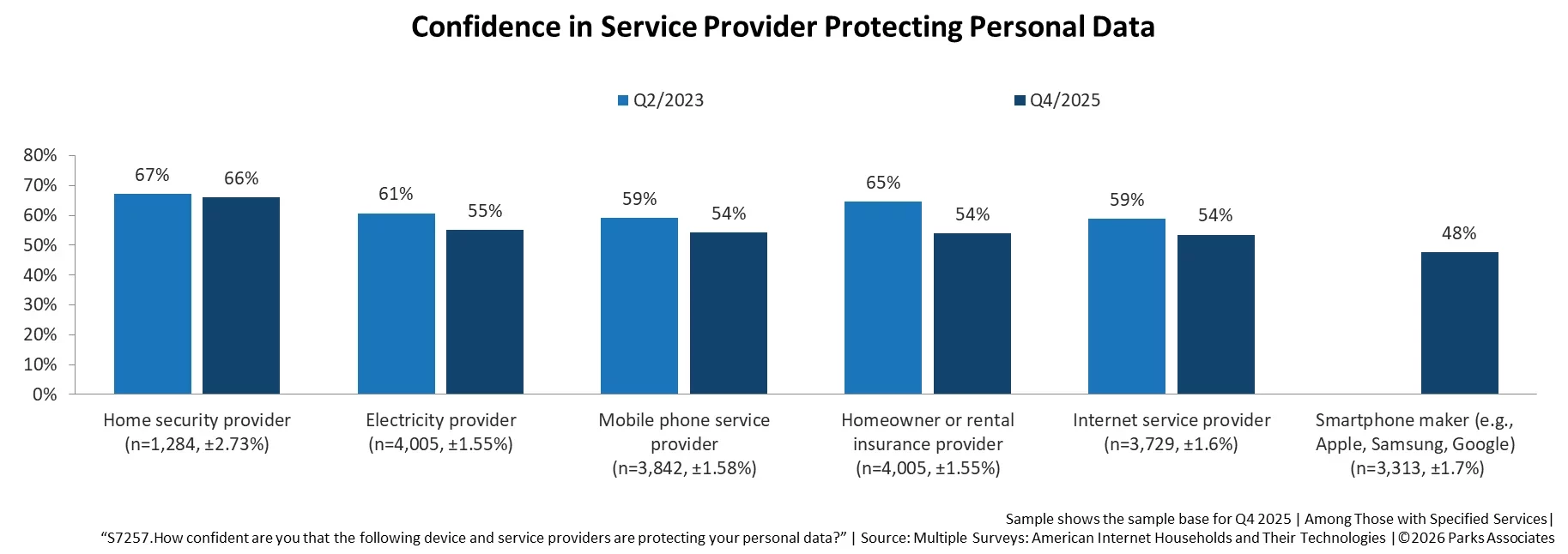
- Confidence in specific types of service providers is modestly declining in most cases.
- Concerns about data privacy and security continues to rank among the top reasons consumers hesitate to adopt smart home devices. While this rate had been declining for years, it is again climbing.
Privacy and security are no longer background considerations but primary barriers to adoption and engagement across connected ecosystems. To sustain growth, providers must move beyond passive assurances to deliver visible, verifiable, and user-controlled protections that actively rebuild confidence and differentiate their offerings.
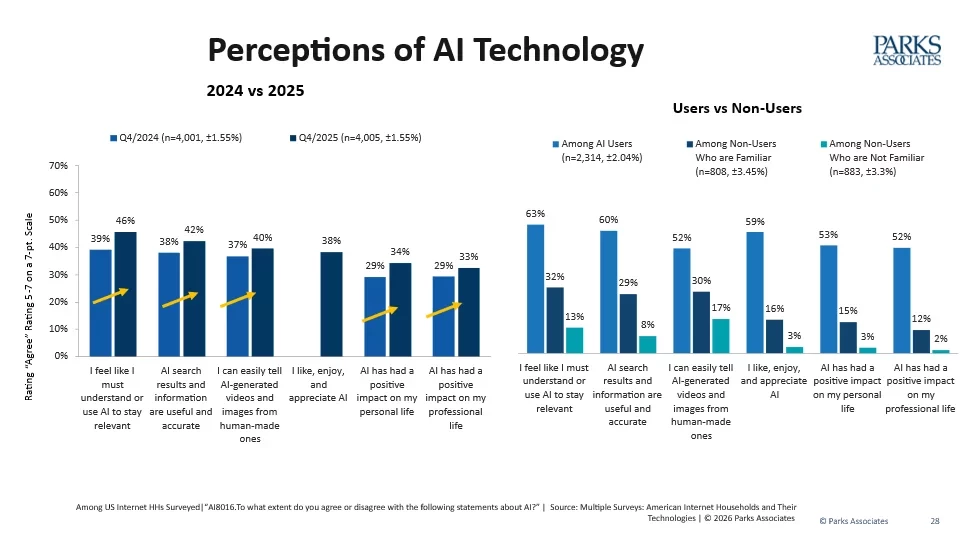
Consumer perceptions of AI are improving, driven largely by direct usage, with AI users far more likely than non-users to see positive personal and professional impact.
Positive perceptions of AI increased meaningfully over the past year, with 34% of consumers saying AI has had a positive impact on their personal lives, up from 29% in Q4 2024, and similar gains for professional impact. These improvements are strongly usage-driven: AI users are significantly more likely than non-users to say AI is useful, accurate, and positively impactful across both personal and work contexts. In contrast, non-users—especially those unfamiliar with AI—remain far less positive, reinforcing that hands-on experience plays a critical role in shifting sentiment.
As AI becomes more embedded into everyday products and services, increased exposure and trial are likely to continue improving consumer perceptions.
Most Trusted Provider
Consumers most trust their home security providers to keep personal data secure; confidence in other service providers is modestly declining.
Those with a home security system or service are implicitly trusting that provider with the safety of their home and family – that trust carries over into protection of personal data. Security providers have an opportunity to expand their services, or differentiate from others offering smart home solutions, by building on that trusted relationship with consumers.
This is an excerpt from Connected Consumer Privacy & Security in the AI Era - just published research from Parks Associates. As connected devices, digital services, and artificial intelligence become embedded in everyday life, consumer concern about data use, surveillance, and digital vulnerability continues to grow. Interested in more info? Contact our Team today. Don't miss our 30th annual CONNECTIONS™: The Premier Connected Home Conference, May 5-7 in Santa Clara, CA.
- Methodology & Key Terms Slide 3
- Executive Summary Slide 5
- Connected Living Evolution Slide 13
- AI Engagement: Familiarity, Use, Perceptions Slide 22
- Connected Living: Concerns, Trust, Data Sharing Slide 33
- Security and Privacy Issues & Actions Taken Slide 46
- Interest & Willingness to Pay for Protection Slide 60
- AI & Home Controls: Competitive Impact Slide 66
- Appendix Slide 75
- Defining Internet households
- Guide to reading Parks Associates charts
- Additional research from Parks Associates

