

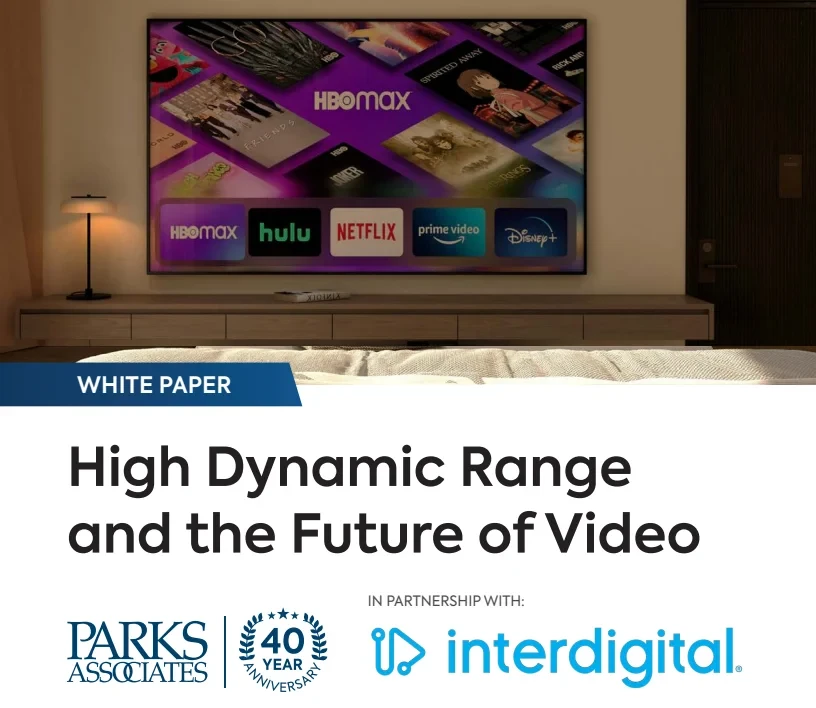
Parks Associates' white paper, in partnership with InterDigital, High Dynamic Range and the Future of Video, examines the evolution of HDR standards, adoption across devices and streaming services, emerging applications, and the challenges shaping the technology's future.
The evolution of video entertainment is about more than higher resolutions. As televisions, streaming services, and content production technologies advance, the industry is increasingly focused on delivering more immersive and lifelike viewing experiences. High Dynamic Range (HDR) plays an important role in this shift, enhancing brightness, contrast, and color to bring greater depth and detail to on-screen images. Its future, however, depends on more than picture quality alone. How effectively the industry integrates HDR across content, platforms, and devices will shape its long-term impact.
Beyond Resolution: Enhancing the Viewing Experience
A sharper image does not necessarily deliver a more realistic one. The range of brightness, detail in shadows and highlights, and accuracy of color all influence how viewers experience content. HDR expands the range of visual information that can be represented, creating richer images when supported by compatible displays and content.
Standards such as HDR10 and Hybrid Log-Gamma (HLG), alongside dynamic formats such as HDR10+ and Dolby Vision, support different approaches to delivering enhanced picture quality. Yet the technology's value depends on how content is produced, distributed, and displayed. Delivering a consistent HDR experience requires coordination across the video ecosystem, from content creators and streaming services to broadcasters and device manufacturers.
New Opportunities Across the Video Ecosystem
HDR's role extends beyond traditional television viewing. Streaming, live production, next-generation broadcasting, mobile devices, and gaming all present opportunities to expand its use. Emerging technologies could further support this evolution, with artificial intelligence enabling new approaches to video enhancement and next-generation codecs offering possibilities for more efficient video delivery.
Realizing these opportunities will require the industry to address challenges such as format compatibility, production complexity, and varying device capabilities. Consumer awareness also matters. Viewers need to recognize the benefits of HDR and have access to compatible content and devices for its advantages to translate into a better entertainment experience.
What Will Shape HDR's Future?
HDR's future will depend on how effectively technical innovation translates into practical benefits for viewers. Advances in standards, processing, and delivery can expand what is possible, but interoperability, production investment, and consumer understanding will influence how widely those benefits are realized.
Explore the complimentary white paper, in partnership with InterDigital, High Dynamic Range and the Future of Video.