

Key Insights
• Apple has lagged for years against competitors Google and Amazon in the smart home hardware race and AI race, and also struggled to hold on as a platform player.
• Apple’s ecosystem strength is not just its overall reach, but the way its devices work together across the consumer’s daily routine. Apple can make each device reinforce the value of the others
• For Apple, the clearest opportunity is to sell more deeply into existing Apple households.
• Winning the smart home will involve layering in services that take advantage of existing capabilities, including advanced artificial intelligence.
Apple’s October 13 Welcome Home event introduced HomeView, HomePod mini 2, a refreshed Apple TV 4K, and Apple Home Collection, bringing new hardware and Siri AI capabilities across entertainment, home control, security, and comfort.
Apple HomeView is a seven-inch smart display for controlling devices, viewing cameras, making FaceTime calls, playing music, accessing household and personal information, and controlling smart home devices. It recognizes up to six household members and includes Siri AI, with personal-context features requiring a paired Apple Intelligence-enabled iPhone or iPad. Tabletop and wall-mounted models each start at $299 and arrive November 13, with wall mounts created by partner Schneider Electric sold separately.
HomePod mini 2 adds the S10 chip, enhanced audio, music-responsive Sound Glow lighting, and support for four-speaker surround sound with the new Apple TV 4K. It also functions as an Apple home hub for remote control and automations.
The fourth-generation Apple TV 4K features the A19 chip, built-in microphones for hands-free Siri, and an updated remote with Precision Finding and an audible locator. It supports Siri AI, smart home controls, and surround sound using four compatible HomePod speakers.
Partner smart home devices from LG include indoor, outdoor, and floodlight cameras; a dual-camera video doorbell; a smart thermostat and room sensor, and a smart deadbolt with hands-free unlocking using a compatible iPhone or Apple Watch. Schneider Electric has also included a smart thermostat in partnership with Apple.
Apple is building out its ecosystem, with peripheral hardware outsourced
Apple has lagged for years against competitors Google and Amazon in the smart home hardware race and AI race. In September, Apple released Siri AI, building on Google Gemini to offer an upgraded assistant experience, and now it is following up with the hardware. Apple is hedging its bets by relying on partner hardware: Apple’s strategy puts the brand at the core of control, and peripheral smart home devices are the responsibility of its partners. Apple’s ecosystem strength is not just its overall reach, but the way its devices work together across the consumer’s daily routine. With smartphones, tablets, watches, computers, earbuds, and smart tags all contributing to the same platform, Apple is positioned to make each device reinforce the value of the others.
The dependencies on the Apple ecosystem for the new device announcements are especially clear in video. Camera history requires an eligible iCloud+ subscription, while the advanced video summaries and natural-language search require compatible Apple hardware and a qualifying plan. Apple is connecting the devices, controls, intelligence, and recurring services within its own environment.
There is some interoperability built in, including Matter support for the lock, thermostats, and sensors. Those provisions matter for individual device compatibility, but they should not be confused with making the complete Apple experience available through competing ecosystems. Even LG’s announced ThinQ support comes with a qualification: its release states that the new products require an Apple home hub. LG is not presenting the partnership as a combined Homey, webOS, and Apple platform.
For Apple, the clearest opportunity is therefore to sell more deeply into existing Apple households. Parks Associates research shows that Apple continues to have the most robust ecosystem across consumer electronics categories and it incorporates multiple devices. Sixty-two percent of US households own at least one Apple device with adoption anchored in smartphones and tablets.
Smart speakers and displays are flat in adoption and need new value
The release of HomeView and the HomePod Mini 2 comes in a smart speaker market where household adoption has barely changed in several years of these devices, remaining within a range from 49% to 53% for smart speakers since 2022. Smart displays are similarly holding within a range of 28-30% in that time. Both devices have reached saturation points, and need new value to grow.
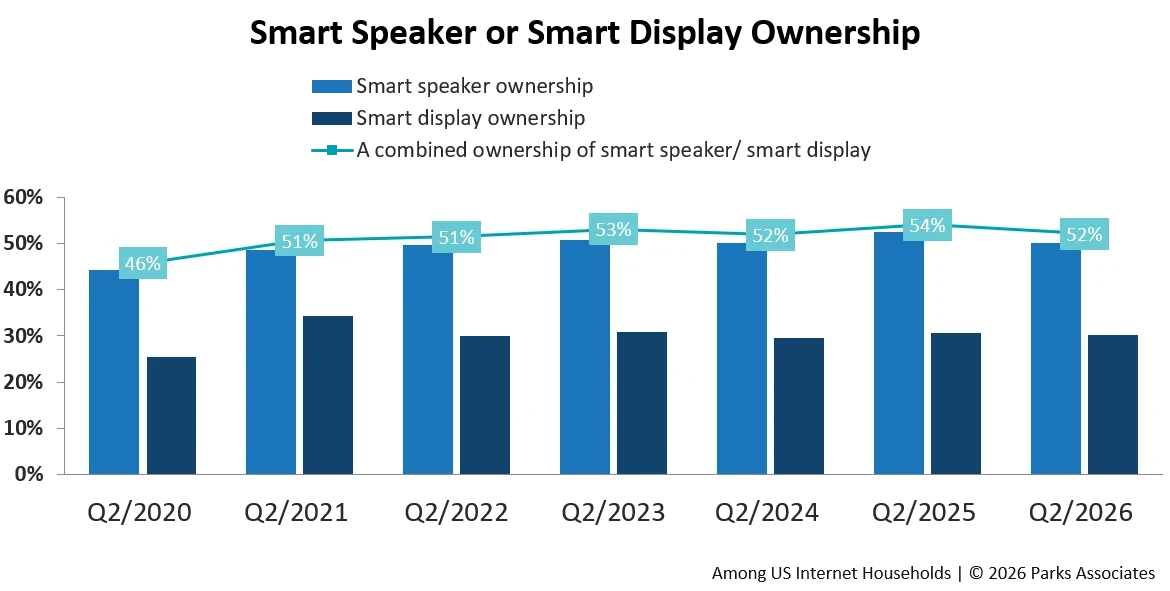
The integration of Siri AI provides the major selling feature for the HomePod, along with the Apple S10 chip. AI in voice assistants may drive adoption increases in the future, but the ability to use voice assistants on smartphones and embedded within various smart devices may hinder adoption. Newer smart speakers on the market from Amazon and Google also have advanced AI assistants (Alexa+ and Gemini), which will also provide stiff competition. As AI becomes common across all smart speakers, other features, such as sensors on a planned smart speaker from OpenAI, may prove even more valuable. Sales of new models with premium features should strongly target smart home device power users. These households see the value in voice control for home management and new features can drive upgrade cycles.
The real value is smart home control, which is fragmented today
Apple’s smart home play enhances its relevance as a control platform, but it has much catching up to do. Amazon remains the top primary smart home platform at 34%, with Google at 13%, and Apple at 10%. Residential security players gained ground since 2024, rising from 13% in Q2 2025 to 16% in Q2 2026. Amazon’s platform and AI strategy have been consistently executed for several years, while both Google and Apple have struggled to implement AI and platform strategies. In Google’s case, an uneven migration from the Nest to Google Home platform may have created frustration and mistrust. Apple’s AI rollout with Siri was expected early in 2025 (iOS 18). Its failure to meet its goals led to negative press and undermined Apple’s position in the smart home, a likely cause of its continued decline in Q4 2025.
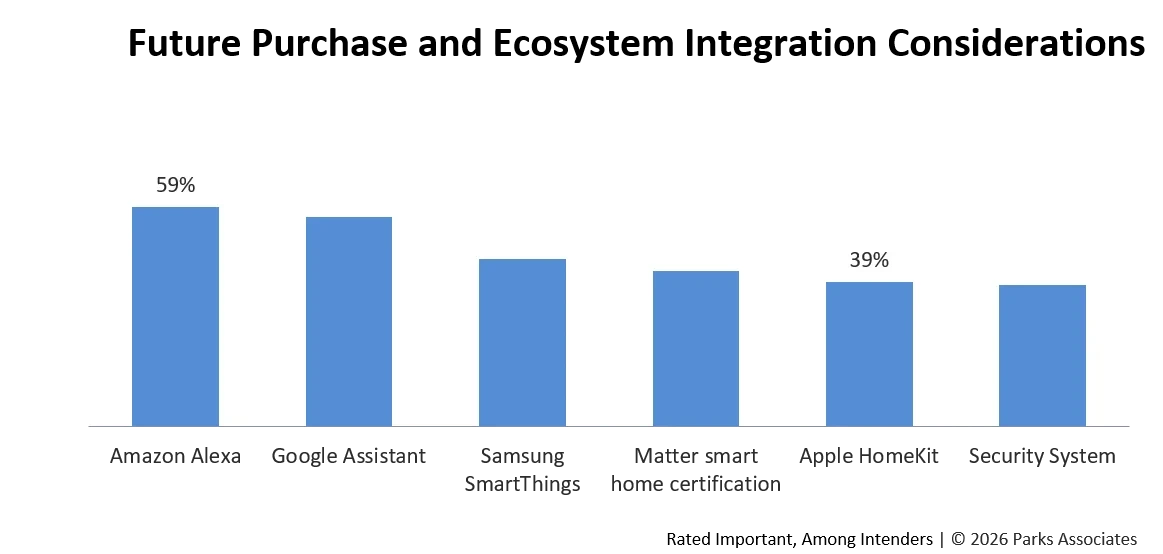
Apple is also not at the top for smart home purchase intenders, with 39% of intenders considering Apple Homekit important as an ecosystem integration consideration, trailing Amazon Alexa, Google Assistant, Samsung SmartThings, and the Matter certification. That LG’s smart lock and both partner thermostats will be Matter-certified may also help Apple in this case.
Who will win: services layered in
As AI and other advanced features become standard across connected devices, and the devices themselves become more commoditized, smart Home OEMs and platform players will need to find other ways to win. Amazon and Google have pushed service opportunities to generate recurring revenue, and this will likely be the future for most companies. Parks Associates tested seven intelligent services with all showing potential to generate billions in annual service revenues.
Cybersecurity Monitoring leads, as consumers increasingly recognize the connected home as a risk environment and may be willing to pay for elevated protection. Maintenance Monitoring, Context-aware Home Security, and Energy Optimization also show potential, suggesting that services framed around preventing problems, reducing false alerts, lowering costs, or improving peace of mind have the best near-term monetization path.
Intelligence itself, in the form of more capable and conversational assistants and agentic, automated experiences, is least able to command service premiums today.
The intelligent home service opportunity is real, but demand is strongest when AI and connectivity are packaged around concrete consumer outcomes—protection, prevention, savings, and support—creating a path for OEMs, security providers, utilities, and platforms to build recurring revenue beyond hardware.
For a comprehensive consumer view of the smart home, see the Quantified Consumer Smart Home Platforms: UX, Loyalty, Monetization.