

The smart home market continues to offer opportunities for growth, but many of those opportunities are coming from areas beyond traditional device categories. Security providers are adding services that extend their relationships with customers, while solar, battery storage, and energy management are becoming more closely tied to connected devices in the home. Across these markets, companies are looking for ways to create additional value from their existing platforms, customer relationships, and installed bases.
Parks Associates research shows consumers are also becoming more interested in solutions that connect different functions in the home. Energy is an important part of this opportunity. Solar ownership remains relatively low, but familiarity and adoption are growing, battery owners are using their systems regularly, and consumers show considerable interest in solutions that coordinate energy devices. At the same time, security providers are evaluating connected health and other adjacent services as traditional residential security becomes a more difficult market for customer growth.
These opportunities have a common requirement: companies need to offer more than another piece of hardware. Products and services need to address a defined consumer need and work within a larger experience.
Security Companies Expand Beyond Traditional Security
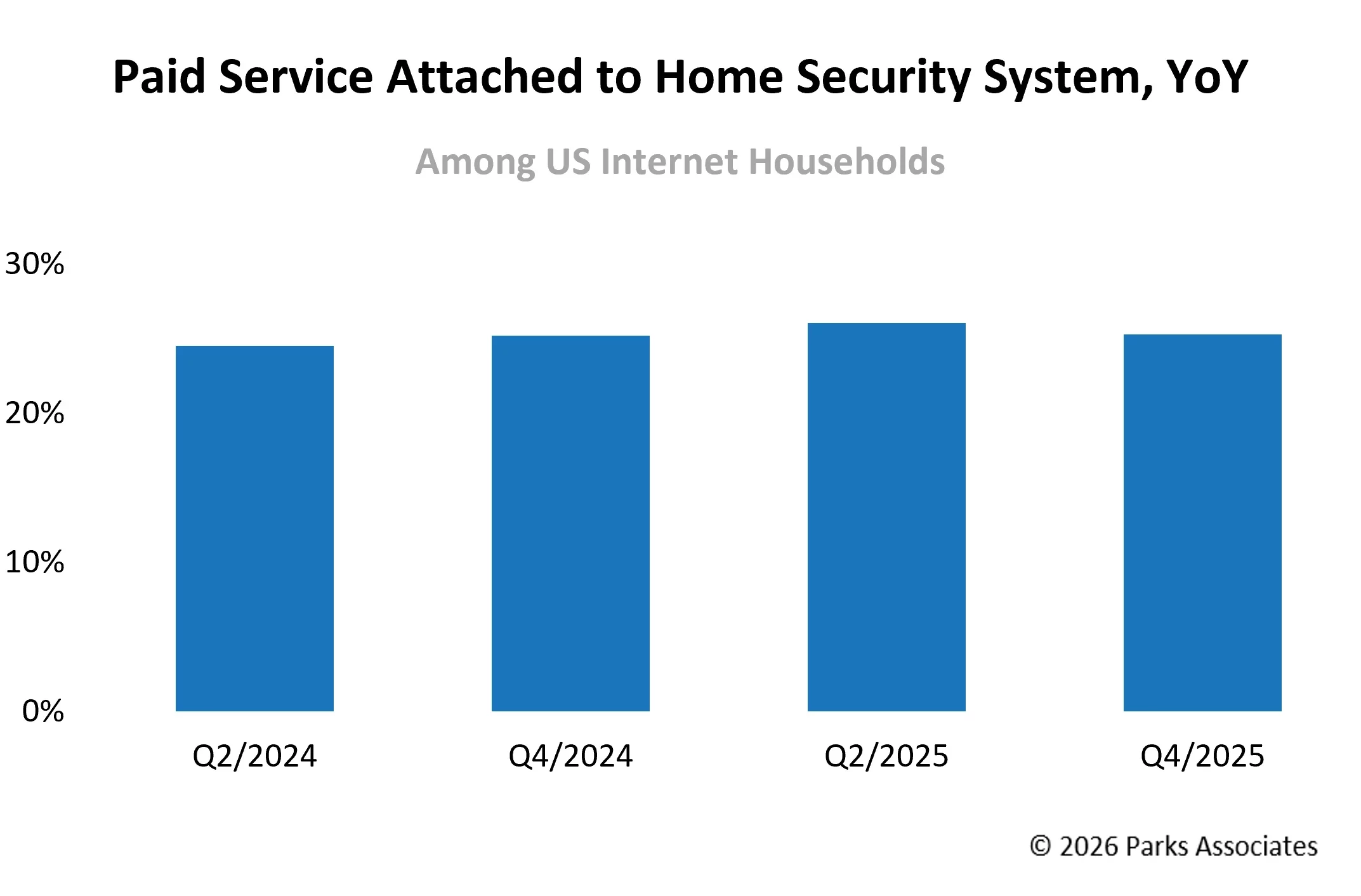
Residential security growth for paid services attached to traditional security systems has stagnated among US internet households, leading providers to look at adjacent markets that can build on their existing service capabilities. Security companies already have several advantages when entering new service categories. They have devices inside the home, automation platforms, recurring customer relationships, and an established position of trust. These assets can support expansion into areas where monitoring, sensing, and ongoing services are important.
Connected health is one example. ADT acquired Origin AI for $170 million, bringing in sensing technology with applications for security as well as potential health and safety use cases. Arlo's acquisition of Aloe Healthcare brings caregiving and medical alert capabilities into its subscription platform, providing a potential path to additional recurring monthly revenue. Wyze is taking a more hardware-oriented approach with its Scale BodyScan, extending its product portfolio from security and smart home devices into personal health.
These strategies target different parts of the market — the audiences can include consumers interested in managing their own health and independence as well as family caregivers who want greater peace of mind regarding an aging parent or other family member. Success requires companies to determine which audience they are serving and what information or service that customer needs.
Security companies entering connected health also take on additional responsibilities. Consumers are already trusting security providers with sensitive information about their homes, but health information introduces a different set of requirements for privacy and accuracy. Fall detection, for example, needs to minimize both false positives and missed events. AI-enabled services also need to provide useful information beyond simple pattern identification that does not result in a meaningful action for the consumer.
For providers evaluating connected health, important considerations for this market opportunity include:
- Privacy: Consumers need clear protections for personal health information.
- Accuracy: Health and safety alerts must minimize false or missed events.
- Consumer control: Users need to understand how information is collected and shared, and should be given the ability to revoke permissions at any time.
- Defined value: AI and analytics need to produce useful information or actions, and be able to bring structure to avoid “data dumps”.
Solar Is Becoming More Relevant to the Connected Home
Energy represents another area where smart home companies should be paying attention. Parks Associates research finds that high familiarity with rooftop solar has nearly doubled in the past two years, increasing from 15% to 28% of U.S. internet households. Ownership also increased and is now at 7% among of US internet households. Solar therefore remains a relatively low-penetration technology, but more consumers understand the category and more households are adopting it.
The market continues to face familiar barriers, including high upfront costs, financing requirements, and payback periods that vary considerably by market. Adoption is also geographically uneven. California has played an outsized role because of its combination of electricity prices, state incentives, net metering policies, financing options, and requirements for solar on many new homes.
The consumer motivation for solar is primarily economic in nature. Parks Associates research finds that four out of five solar owners cite lower electricity bills as a primary motivation, ahead of government incentives. The Residential Clean Energy Credit expired at the end of 2025, creating the possibility that some 2026 purchase timelines were accelerated by consumers seeking to qualify before the deadline. If the loss of the credit had fundamentally weakened consumer demand, however, purchase intentions would be expected to decline entering 2026. Parks Associates research instead shows that purchase intentions for rooftop solar continued to increase. Rising electricity prices, concerns about grid reliability, equipment costs, and new financing options are all factors that may be supporting continued consumer interest.
Battery Storage Adds New Use Cases
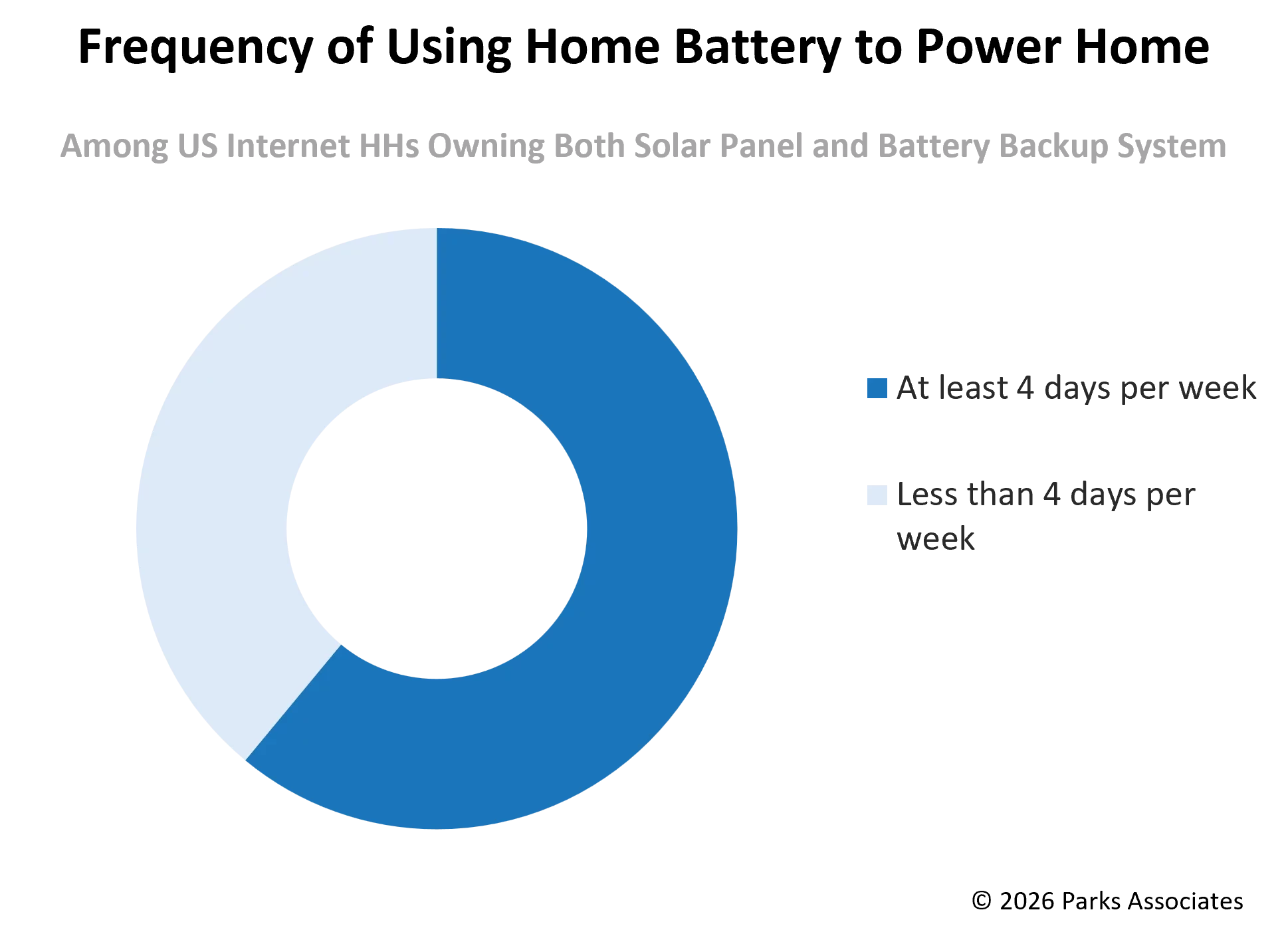
Battery storage changes the value proposition because it gives households greater control over when they use the electricity they generate or purchase. Parks Associates research finds that almost two-thirds of consumers who own both solar and a home battery use their battery to power the home more than four days per week. That level of use indicates batteries are becoming part of routine household energy management, interfacing with time-of-use rate plans.
The main consumer and utility use cases include:
- Backup power during outages
- Reducing electricity purchases during high-rate periods
- Storing excess solar production for later use
- Participating in demand response programs
- Supporting virtual power plant programs
These use cases give solar and storage providers more ways to demonstrate an economic return. They also connect residential energy equipment more directly to the smart home because getting the most value from a battery increasingly requires coordination with other devices and household loads.
New Solar Products Could Expand the Addressable Market
Traditional rooftop solar cannot serve every household. Renters, apartment residents, consumers with unsuitable roofs, and households unable to afford a complete rooftop installation have largely been left outside the residential solar market. Balcony and plug-in solar offer a potential alternative.
These products have gained traction in Europe’s often dense multifamily housing stock. Companies are beginning to adapt the concept for the U.S., but commercialization depends on syncing with or changing electrical codes and safety standards. Recent new restrictions affecting foreign-manufactured solar inverters under the FCC’s covered list for section 2 of the Secure and Trusted Communications Networks Act of 2019 add another issue for manufacturers evaluating the U.S. market.
For the smart home industry, this also introduces another distributed energy resource that could eventually be incorporated into energy management platforms.
Home Energy Management Brings the Pieces Together
Solar, batteries, connected thermostats, EV charging, and smart appliances have generally been developed and marketed separately. Consumers can receive more value when these products coordinate their operation. A household might charge a battery when electricity is inexpensive, use stored energy during an expensive rate period, adjust HVAC consumption during a demand response event, and schedule EV charging based on available solar generation.
The installed base of smart home products provides a starting point for this market. More than one-third of smart homeowners already coordinate connected devices through automations and routines. Consumers, however, also increasingly report problems setting up those routines.
The opportunity for the industry is to reduce that complexity. Consumers should not have to understand every interaction among solar production, battery state of charge, electricity rates, HVAC loads, appliances, and EV charging. The system needs to manage those interactions while giving the consumer control over the outcomes that matter to them.
More insights from Parks Associates research on home energy management can be found in the Quantified Consumer study, Grid-Ready Homes: Home Energy Insights, Assets, & Bundles.

