

The smart home market continues to expand beyond familiar categories such as security cameras, thermostats, lighting, and door locks. Increasingly, connectivity is becoming part of the home’s core infrastructure, including the systems that manage water. Companies are in search for additional experiences to elevate and grow, and Kitchen and bath are emerging categories as the core security/video/access control use cases mature.
To capture that evolution, Parks Associates has expanded its Smart Home and Security Market Tracker to include two new product categories: smart kitchen faucets and smart showers.
These additions are significant not simply because they represent more connected devices. Smart faucets and showers bring the smart home into plumbing, remodeling, water management, and professionally installed systems. They also highlight opportunities for smart home platforms, manufacturers, builders, integrators, utilities, insurers, and service providers to participate in a new layer of the connected home ecosystem.
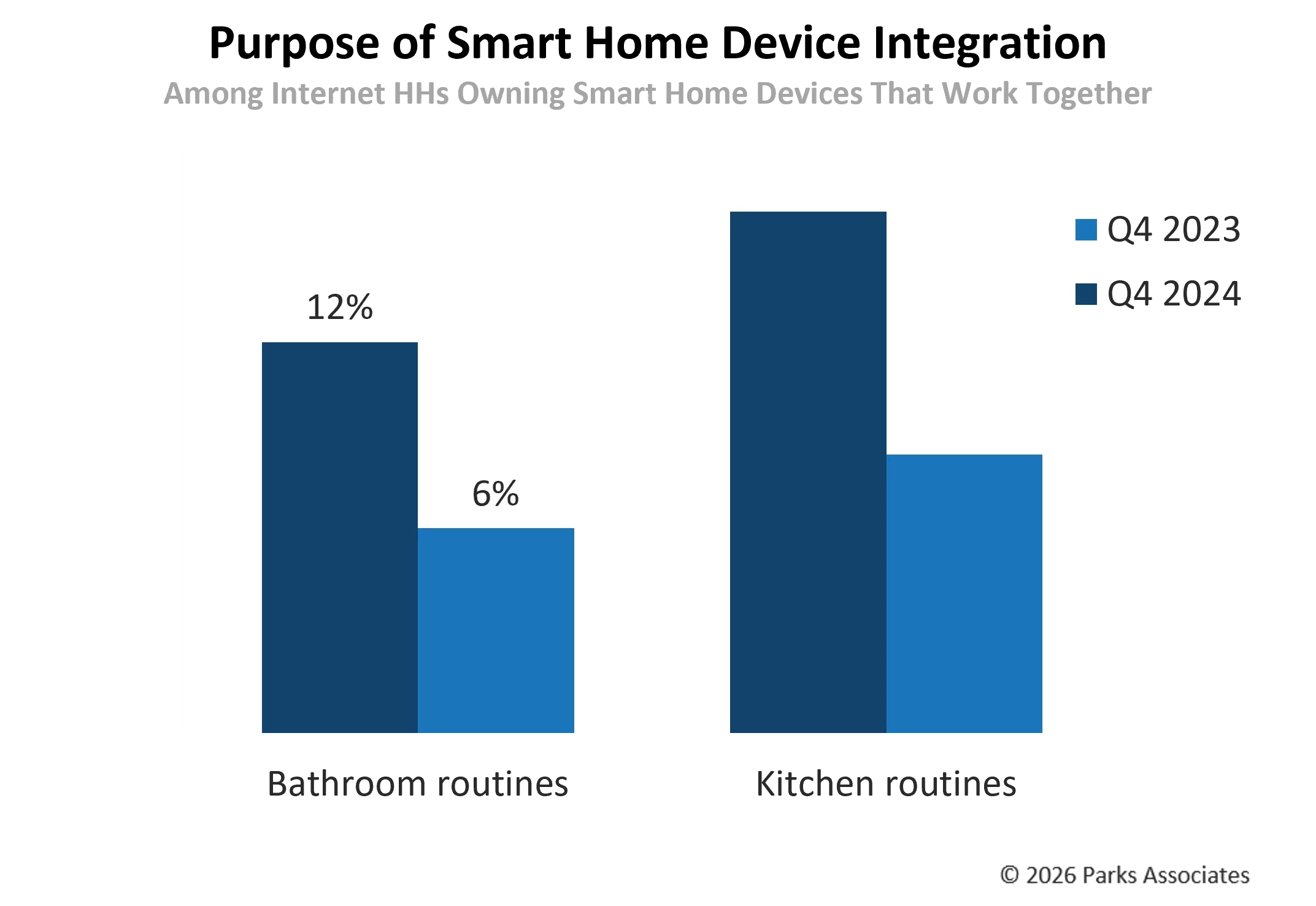
And increasingly, smart home device owners are looking to create interoperable experiences within the entire home, including the bathroom and kitchen. Parks Associates quarterly consumer survey of 8,000 US internet households shows that among smart home device owners whose devices work together, 12% do so for bathroom routines — double the rate a year prior. Kitchen routines follow a similar trajectory.
Smart plumbing is becoming a premium connected home category
Smart kitchen faucets and smart showers occupy a very different position in the consumer purchase journey than many traditional smart home products.
Connected kitchen faucets tracked by Parks Associates range from roughly $400 to more than $2,500, depending on the manufacturer and configuration. Smart shower systems move even further into the premium market, with core systems starting around $1,300 and some configurations exceeding $8,000 before optional accessories.
At these price points, connectivity is part of a broader premium experience. Manufacturers are using voice control, remote activation, programmable presets, precise temperature management, water-use information, and other digital features to differentiate products that are already important design and remodeling decisions.
That creates opportunities well beyond consumer electronics retail. Builders, plumbers, electricians, kitchen and bath designers, home technology integrators, and remodelers all become key channels for distribution and install.
Voice leads today, while broader interoperability remains limited
The new Smart Home Tracker data also reveals an interesting interoperability story. All smart kitchen faucet products tracked by Parks Associates use Wi-Fi, and the three brands represented support both Amazon Alexa and Google Assistant. Yet none of the tracked products currently supports Matter, Thread, Apple Home, SmartThings, Control4, or other major platforms. Smart showers show a similar pattern.
For smart home platforms, this represents both a challenge and an opportunity. Consumers expect connected devices throughout the home to work together. As kitchens and bathrooms become smarter, ecosystem providers will have an opportunity to extend automation and control beyond traditional smart home categories.
A future household experience could connect water, energy, security, lighting, and comfort into coordinated routines. Today, however, smart plumbing largely remains its own connected island.
Smart showers create a clear role for professional channels
Installation is another important difference between these emerging categories and many DIY smart home devices. Every smart shower system tracked by Parks Associates requires professional installation which may involve both the use of plumbing and electrical contractors. That dynamic creates an important role for plumbers, builders, contractors, and technology integrators who may be able to steer customers towards smarter solutions as well as install them.
It also raises a broader strategic question for smart home service providers. Historically, professionally installed smart home offerings have centered on security, networking, entertainment, lighting, and climate control. Connected plumbing could become another category where service providers help consumers select, install, integrate, maintain, and manage increasingly sophisticated home systems. The manufacturers tracked generally do not directly provide that connection to installers directly through the product websites, but can facilitate that relationship.
The opportunity is particularly relevant in new construction and remodeling, where homeowners are already making decisions about fixtures and infrastructure.
Personalization is emerging as a key smart shower benefit
Unlike categories in smart water that Parks Associates traditionally tracks such as leak detection and smart water shutoff, smart showers open up use cases beyond basic detections and automations which are easily forgotten, Manufacturers are moving toward personalized home experiences. Remote activation through smartphone apps, programmable experiences, and support for different users are becoming common features.
For example, Delta supports 12 programmable presets incorporating variables such as duration, temperature, and optional audio. Moen also supports 12 presets through its app, with two available directly from the shower controller. This allows consumers to personally tailor settings and enjoy a consistently elevated experience, a significant differentiator from traditional shower experiences.
Water management creates other smart home adjacencies
Perhaps the most strategically important aspect of these categories is their connection to water. Smart plumbing products can combine convenience and luxury with greater visibility into household water use. Some products already incorporate capabilities such as usage information, eco modes, precise temperature and flow control, and connections to broader water-management services.
That creates potential relevance for companies outside the traditional kitchen and bath industry. Utilities are exploring ways to help households better understand resource consumption. Insurers have a strong interest in reducing water damage. Smart home platforms are looking for new services that create recurring consumer value. Security providers are increasingly extending their value propositions into whole-home monitoring and management. Connected plumbing sits at the intersection of all these markets.
Additionally, the total smart bathroom experience could tie into music and entertainment, moods and healthcare. Routines can be coordinated among other devices, like smart lighting, smart speakers, smart ventilation, smart interior door locks, and smart shades.
The smart home value is in interoperable ecosystems
The smart home industry is moving away from selling point-solutions to users and towards ecosystems. The bathroom and the kitchen are central to that strategy, but are only just developing, especially for water management. Smart home devices are no longer defined only by stand-alone devices that consumers plug in, mount on a wall, or connect to an app. Connectivity is becoming embedded in the fixtures and infrastructure consumers expect to remain in their homes for many years. Smart faucets and showers create new touchpoints for platform integration, professional installation, personalization, water management, premium services, and cross-industry partnerships.
Source: Parks Associates Smart Home Tracker + Security, Q2 2026.