

At WWDC 2026, Apple announced a deceptively important smart home update: HomeKit Secure Video cameras will gain Apple Intelligence features that can describe what happened in video clips, search footage using natural language, surface noteworthy clips, and support 4K streaming and recording on compatible cameras. The Verge notes that the search capability can work across connected cameras, helping users find moments like a package delivery without manually checking each feed.
This may not have generated the same attention as Siri AI, but for the smart home and security markets, it points to a major shift. The value of video security is moving beyond motion alerts and person detection toward contextual awareness: What happened? Where did it happen? Which camera captured it? And can the system find the answer without the user scrubbing through hours of footage?
From camera intelligence to home intelligence
Overwhelmingly, AI in residential security is tied to camera location and use case. Video doorbells detect people and packages at the doorstep. Floodlight cameras may light up and detect presence around a yard or driveway. An indoor camera recognizes an animal. These features are useful, but they remain tied to individual devices, brands or apps.
Apple is approaching the market with a different model. The intelligence lives in the Home experience, not just in the camera. A user need not remember whether the driveway camera, doorbell, or side-yard camera captured an event. They can ask the Home app what happened and find the relevant clip. This is the best type of interoperability: cross-brand experiences that happen without the user needing to know the mechanisms making it work.
Apple is not necessarily opening the market to every camera—support still depends on compatible HomeKit Secure Video cameras, iCloud+, Apple Intelligence-enabled devices, and a home hub. Apple’s own iOS 27 notes say compatibility varies by accessory and software version, and Apple did not announce Matter camera support.
Still, within the Apple Home ecosystem, this is meaningful. It allows AI search and descriptions to operate across supported cameras from different manufacturers, creating a unified experience on top of a fragmented device market. For consumers, that matters more than the underlying technical standard. The experience becomes interoperable when the user can search the home, not the device.
Parks Associates data shows the market is ready
This update arrives as AI-enhanced security services are already gaining traction. Parks Associates research finds that 15% of security system owners pay for AI-powered enhancements to their security services today.
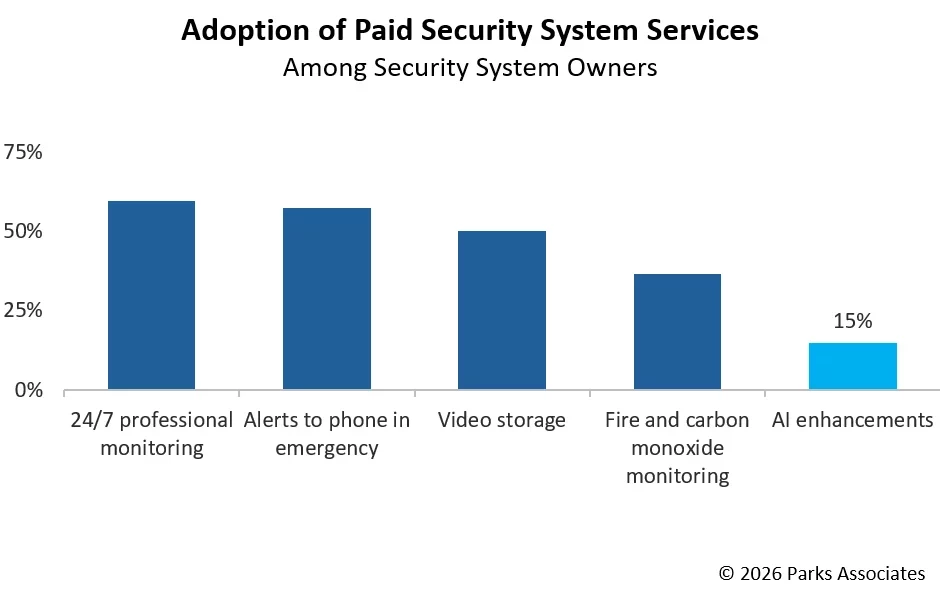
The features Apple highlighted align closely with the premium AI capabilities already appearing in the market. Parks Associates data shows that among households receiving premium AI enhancements as part of their security service, 78% have access to smart video search and 65% receive AI-powered video descriptions. Among all security system owners, those features are far less common (12% and 10%, respectively) showing how much room remains for these capabilities to move from premium add-ons to mainstream expectations.
Consumers are not asking for “AI” in the abstract. They want fewer false alerts, faster answers, and more useful context. Apple’s generated descriptions and natural-language search address a very practical pain point: video overload. The more cameras a household installs, the harder it becomes to manage the volume of video events. AI search turns stored footage into something usable.
Why this matters for the competitive landscape
Apple’s move reinforces a broader industry trend: AI will become a core differentiator for security platforms, not just a premium feature on individual cameras. Ring, Google Nest, Arlo, eufy, Aqara, and others are all adding intelligence to video services, but Apple’s advantage is its ability to make the Home app the aggregation point across supported devices.
This is especially relevant because many households do not buy every camera from one brand. A consumer may have a video doorbell from one company, an outdoor camera from another, and indoor cameras from a third. The more mixed the home becomes, the more valuable the platform layer becomes.
For device makers, this creates both opportunity and pressure. Cameras that support broader ecosystems can participate in larger AI experiences. Cameras that remain locked to a single app risk becoming silos. For service providers, the lesson is similar: the next phase of AI monetization will depend less on isolated features and more on integrated experiences that work across the home.
The privacy angle remains central
Apple is also positioning these capabilities within its broader privacy-first AI architecture. Its WWDC announcement emphasized on-device processing and Private Cloud Compute, and says that when Private Cloud Compute handles requests, personal data is not stored or made accessible to Apple.
That message matters in home security. Cameras capture some of the most sensitive data in the connected home: who comes and goes, when children arrive home, where packages are left, and what happens around private spaces. AI video analysis can be valuable, but only if consumers trust how it is handled.
Parks Associates finds that AI-forward branding alone does not guarantee purchase intent; consumers respond to clear utility, transparency, privacy by design, and practical service benefits. Apple’s announcement addresses consumer demands: it does not sell AI as a novelty, but embeds it into its video solution as a practical benefit.
The bottom line
Apple’s HomeKit Secure Video update is important because it brings together two of the biggest themes in connected home security: AI and interoperability.
AI makes camera footage more useful by turning video into searchable, summarized, contextual information. Interoperability makes that intelligence more valuable by allowing the user to search across the home rather than through separate feeds, devices, and apps.
The smart home market has spent years adding connected devices. The next phase will be about making those devices work together intelligently. Apple’s WWDC announcement is another sign that home security is moving from detection to understanding—and from single-camera alerts to whole-home awareness.
For more Parks Associates research on smart security services and AI enhancements see Quantified Consumer: Smart Home Platforms: UX, Loyalty and Monetization