
ADT’s acquisition of Origin AI marks a pivotal moment in the evolution of home security and it may have just reshaped the strategic options for broadband providers.
Origin AI pioneered commercial Wi-Fi sensing, using changes in RF signals to detect motion and presence without cameras, wearables, or dedicated motion sensors. For ADT, the deal strengthens its position in a market increasingly defined by contextual intelligence rather than standalone devices. For ISPs, however, the implications are more complicated.
This acquisition highlights two parallel industry shifts:
- Security systems must become more contextually aware, relevant solutions without increasing privacy friction.
- ISPs are still searching for a defensible, differentiated position in the smart home and services that can both anchor a new type of bundle and produce significant recurring revenue. Security services fit the bill, and AT&T jumped into the market with its new Connected Life offering with Google and Abode partnerships in December.
Why Wi-Fi Sensing Matters Now
The traditional security stack — door/window sensors, PIR motion detectors, indoor cameras — is no longer enough to drive long-term engagement or differentiation. Consumers expect systems that:
- Understand presence versus absence
- Reduce false alarms
- Enable automation without constant user input
- Deliver awareness without adding visible hardware
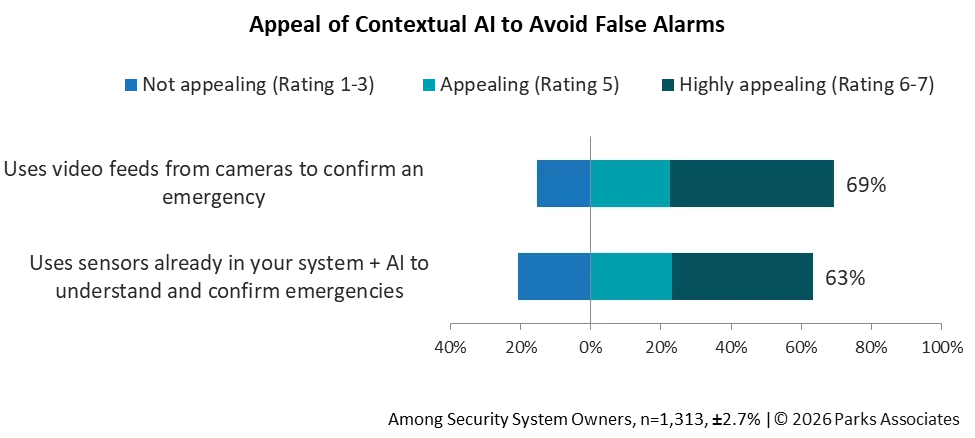
63% of security system owners find it appealing for their systems to use information the system captures, plus AI, to understand and confirm emergencies – nearly as many as are interested in using camera feeds.
At the same time, indoor cameras face growing privacy resistance. Wi-Fi sensing addresses adds intelligence without indoor cameras and also enables contextual awareness at the infrastructure layer of the home: at the router. And that’s where this deal becomes especially strategic and impacts ISP strategies.
The ISP Play: Router as Intelligence Hub
Broadband providers have viewed the gateway/router as their beachhead into the smart home, though it’s been underutilized in practice so far. Wi-Fi sensing represents a particularly attractive opportunity because it:
- Leverages hardware ISPs already control
- Adds differentiation without truck rolls
- Creates recurring service revenue potential
- Positions the ISP as an intelligence provider, not just a bandwidth utility
Origin AI is one of the key technology enablers for that strategy, and several ISPs already use Original AI’s technology (including Verizon, Deutsche Telekom, and Airties). With ADT acquiring the founder and core sensing IP, ISPs now face a new reality: one of the most security-focused Wi-Fi sensing innovators is no longer neutral.
I see two really interesting scenarios that have opened up for ADT here:
- ISPs partner with ADT: One path forward is collaboration. ISPs could embed ADT-powered Wi-Fi sensing into managed routers and offer “Security powered by ADT”. This gives ISPs faster time to market, a credible security brand, and potential revenue share, while opening up millions of new households for ADT and lowering ADT’s customer acquisition costs.
- ADT becomes an ISP: ADT could leverage this acquisition not only to enhance security — but to control the underlying connectivity layer. ISPs are already beset by new competition from T-Mobile, Verizon, and AT&T’s 5G at Home fixed-wireless offerings, and this competition has expanded to MVNO providers who are leveraging the cellular networks to provide 5G at Home as well (e.g., Mint Mobile, Ultra Mobile).
5G Home Internet lowers the barriers for entry for alternative providers like ADT. Operating as an ISP, ADT could offer a vertically
integrated smart home services model and tackle the top user experience issue with the smart home: loss of wireless connectivity.
What’s Next for ISPs and Contextual, Ambient Intelligence?
We expect more movement from ISPs in the smart home space in 2026. This deal with ADT and Origin could increase demand for alternate sensing and contextual technology providers, like Ivani, Ubiety, and Cognitive Systems. The router is no longer just a gateway to the internet, it is the gateway to intelligence in the home, and competitive pressures will force ISPs to clarify their product roadmaps in the smart home.
For more information on Parks Associates research, email info@parksassociates.com. Please join us for the 30th annual CONNECTIONS Conference, hosted May 5-7, 2026 in Santa Clara.