

Rumors that Apple is preparing a new smart home hub and working with LG on connected home products raise an interesting question: Can Apple make up ground in a market where Amazon, Google, and Samsung have spent years building their positions?
Apple is late to this market in many respects. It has a loyal customer base, a strong consumer ecosystem, and an established reputation for privacy, but its smart home platform has not achieved the same reach as its other products. LG brings something different, with its ThinQ platform, connected appliances, televisions, and Homey, the smart home platform it acquired through Athom.
As defined by Parks Associates research, a consistent, one-quarter of US Households are Apple loyalists, owning 3+ Apple devices. All other brands rank far behind.
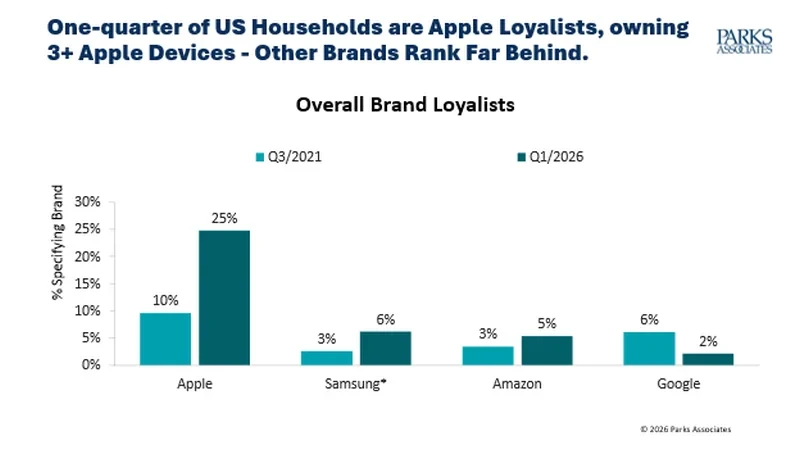
The rumored partnership between Apple and LG is interesting, particularly because Parks Associates' research shows that consumers are not firmly committed to their existing smart home platforms.
Our latest research finds that 47% - 49% of US internet households own at least one core smart home device. Among smart home device owners, the average household has six devices. Adoption has been slow and steady, although purchase intentions remain high. The industry has made progress getting connected products into homes, but there is still considerable work to do in making those products easier to use together, and creating a better installation, set up, and support experience.
Smart home devices owners use many platforms for control and four in five smart home device owners say they would consider switching their primary platform. The top reason, cited by 46%, is the ability to control all their devices in one place. Consumers also point to better security and privacy, broader compatibility, and easier setup.
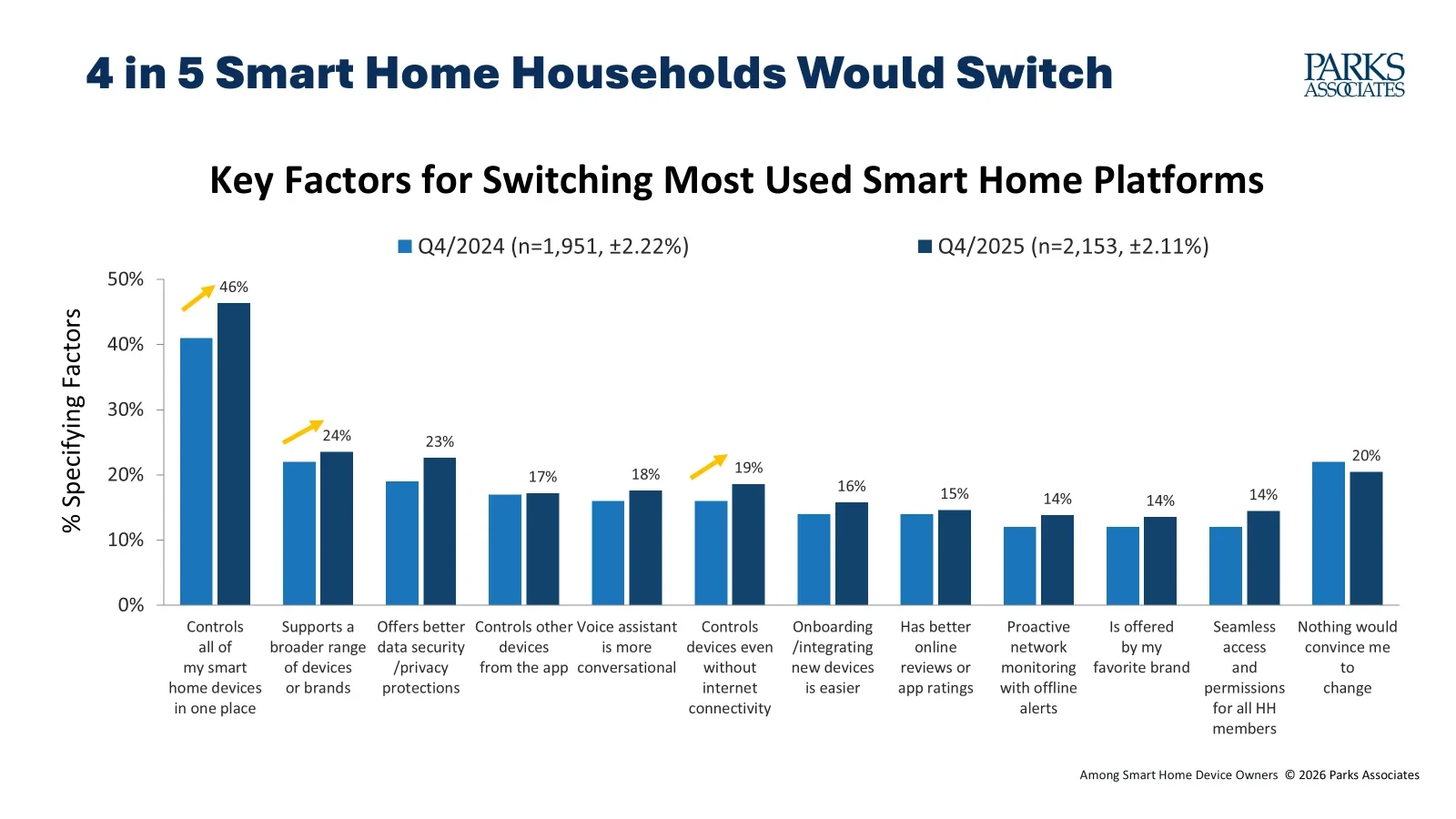
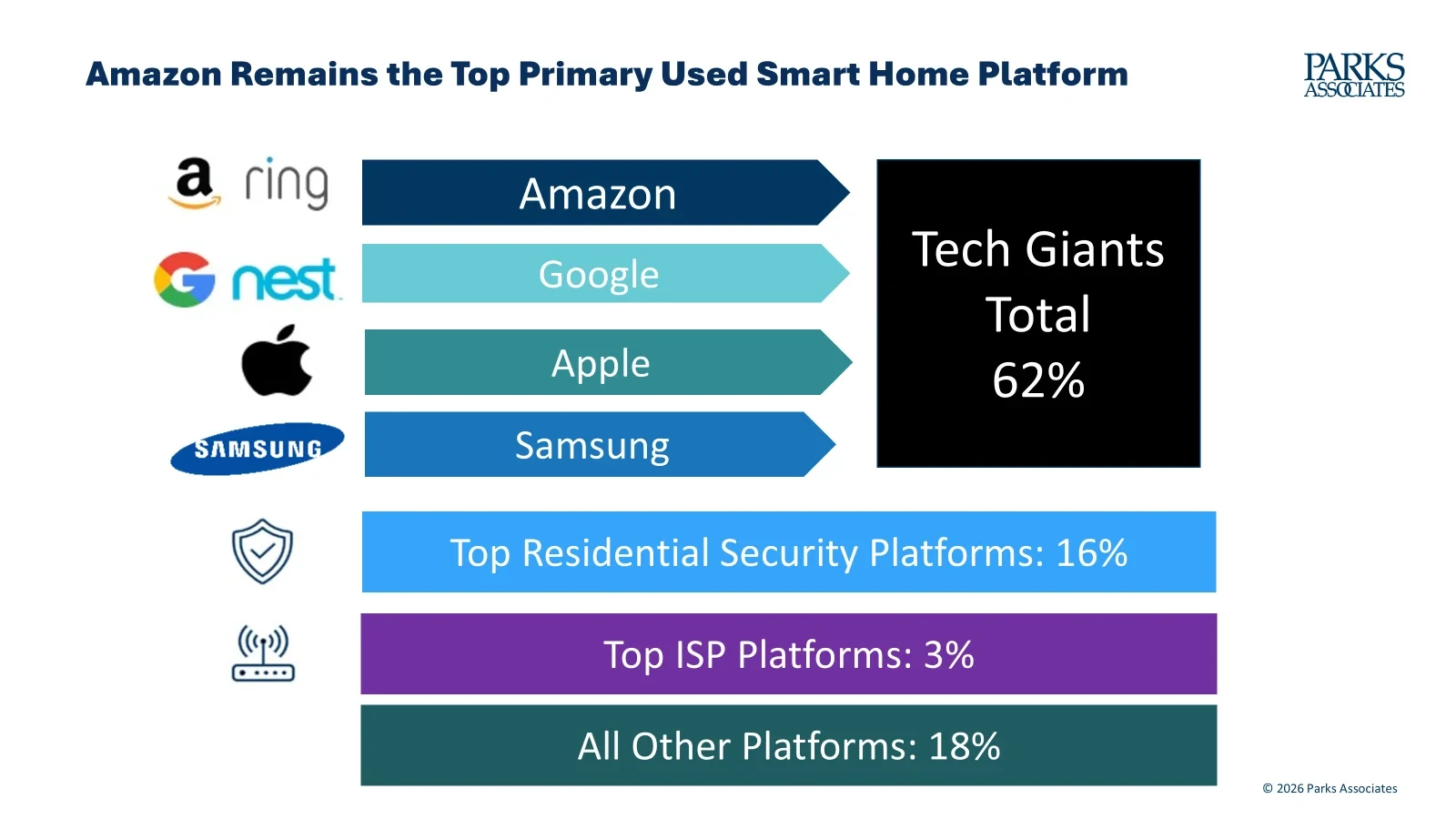
That is a significant finding for Apple, given its incredible board userbase. Amazon remains the leader in primary smart home platform usage at 34%, followed by Google at 13% and Apple at 10%. Those positions are well established, but consumers are clearly willing to reconsider their choices.
Apple does have an advantage in loyalty among its existing Home users. The percentage of primary Apple HomeKit and Apple Home app users who say nothing would convince them to switch increased from 13% in 2024 to 20% in 2025. LG ThinQ also improved, from 9% to 15%. Google Home and Samsung SmartThings lost ground on the same measure.
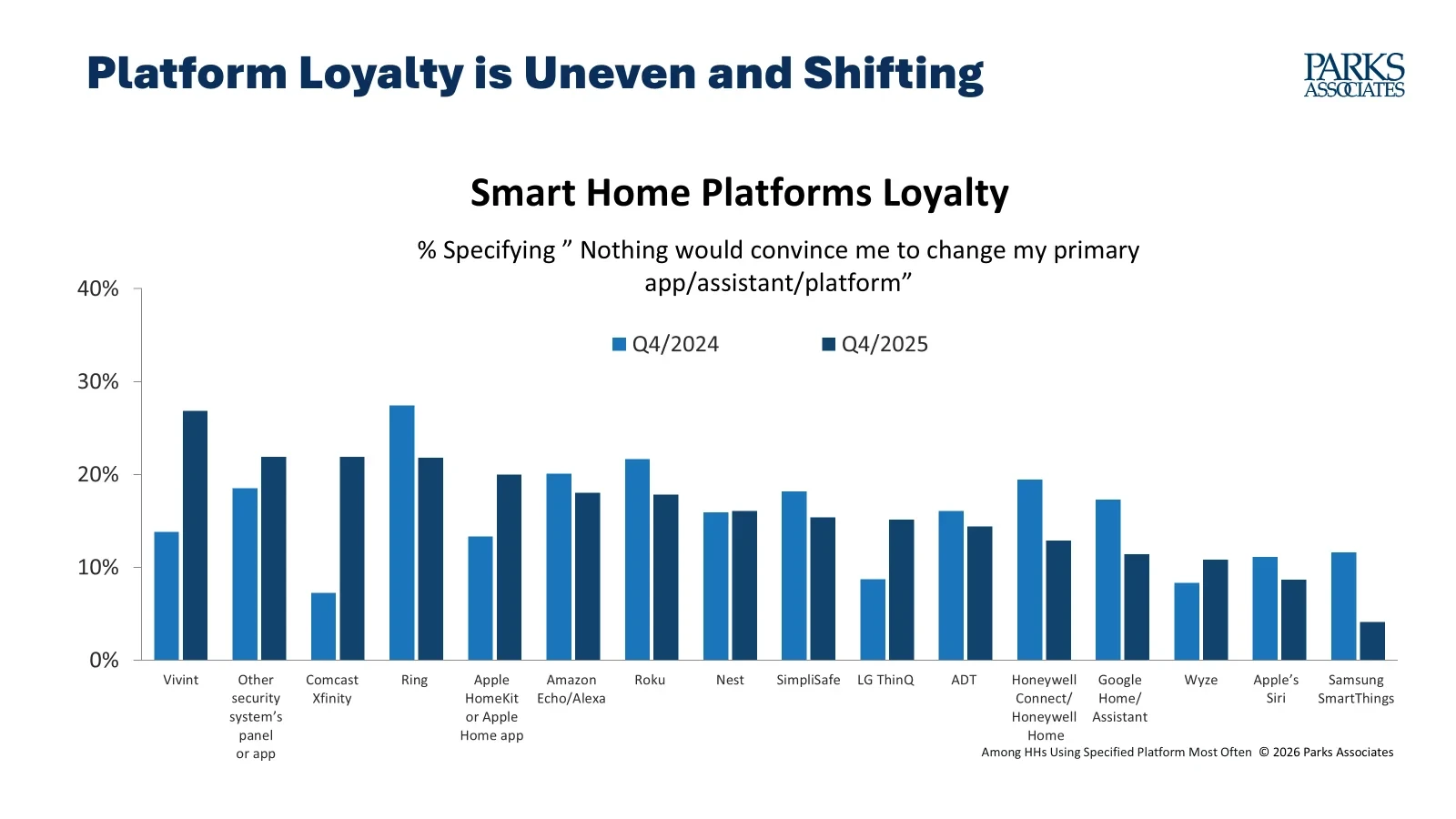
Parks Associates research finds that 48% of smart home device owners now use a single platform to manage their devices, up from 36% in 2024. Consumers are moving toward fewer platforms, even as the number of companies competing for that position continues to grow. That competition is growing beyond the major consumer technology companies.
Security providers have been gaining ground. Their share of primary smart home control increased to 16% in Q2 2026. These companies have an established relationship with the household, often through a paid monitoring service, and they are extending that relationship into cameras, automation, energy management, and new forms of home monitoring.
ADT's acquisition of Origin AI is a good example of how the security industry is investing in technologies that go beyond traditional alarm systems. Wi-Fi sensing could support additional services related to safety, awareness, and monitoring in the home.
Security companies also have something that many device manufacturers want: recurring service revenue and an ongoing relationship with customers. That gives them an advantage as connected home products become more closely tied to services.
Broadband providers have a similar opportunity, although their share of primary smart home control remains small at approximately 3%. Connectivity providers already provide the network that supports connected devices and are expanding managed Wi-Fi, network security, and device support. The ability to combine broadband, mobile, security, and other services makes ISPS even more relevant to the smart home market. This is an area Parks Associates tracks extensively, including the market competition, speeds, routers, gateways, and value added services provided.
LG's television business adds another dimension to the potential announcement made together with Apple. Smart TV ownership has increased from 60% of US internet households in 2022 to 71% in 2026, according to Parks Associates research. The television is already an important interface for entertainment, and there are opportunities to extend its role into home control.
Roku is an early example, with approximately 10% of smart home device owners reporting using Roku as a smart home control platform. LG has the ability to connect its televisions, appliances, and smart home technologies, potentially making the TV another point of access for managing the home.
This also brings streaming, advertising, and direct-to-consumer services into the discussion, and more evidence of the convergence among the home controls, safety and security and the video entertainment and consumer electronics ecosystems. Television platforms have a growing interest in maintaining consumer engagement beyond the initial hardware sale. Smart home functionality could become part of that strategy, although the value will depend on whether consumers find it useful.
AI will also influence how this market develops. Amazon and Google have moved more aggressively in bringing AI capabilities to their platforms, and security providers are investing in AI-enabled monitoring and automation. Apple will need to show how its approach improves the smart home experience rather than simply adding another assistant.
Parks Associates research shows that consumers are less concerned with which company controls the platform than with whether it works. They want devices to connect, routines to function reliably, and fewer applications to manage. Privacy and security are increasingly part of that decision.
Apple and LG have the assets to become stronger smart home competitors. Apple's loyal customers and LG's investments in appliances, television, and Homey could be a useful combination. But the market has changed considerably while Apple has been developing its strategy. Amazon and Google remain important players, security providers are expanding their role, and broadband companies are looking for ways to build on their existing customer relationships.
The opportunity for Apple and LG is to solve problems that have limited the market for years: getting devices to work together, making automation useful, and giving consumers a reason to invest in connected services.
With 80% of smart home device owners willing to consider another platform, the market is still open to change. Apple and LG may have an opportunity, but they will have to earn that position.
Source: Parks Associates Research: Smart Home Dashboard: Q2 2026; Smart Home Platforms: UX, Loyalty, Monetization; Tech Ecosystem Dashboard Q1 2026.