

The next phase of consumer technology growth will be driven by ecosystems, not individual device sales. The companies that win will be those that make hardware, software, services, AI, and daily use cases work together in ways that feel useful, easy, and trusted. Growth will require stronger catalysts, including AI-enabled home management, security and monitoring, energy management, caregiving, and personalized whole-home control.
The consumer technology market is entering a more mature phase, where growth is less about first-time device adoption and more about ecosystem depth, replacement cycles, and the ability to connect devices and services across daily routines. US internet households now average 17.8 connected devices, only slightly above prior years, showing that the connected home is still expanding but at a slower, more incremental pace. CE devices remain the backbone of the connected household, with smartphones, computers, entertainment devices, and smart speakers accounting for most of the installed base.
Smartphones remain the anchor of the consumer technology ecosystem. Purchase rates rose above the 2022-2024 baseline in 2025 and remained elevated in Q1 2026, though purchase intentions have softened. This suggests the recent upgrade cycle may be cooling, but smartphones continue to drive engagement across payments, apps, wearables, smart tags, smart home controls, entertainment, and cloud services.
The living room is becoming one of the most important battlegrounds for ecosystem control. Smart TVs are now the dominant primary streaming device, rising from 39% in Q1 2018 to 62% in Q1 2026, while gaming consoles have declined sharply as primary streaming devices. The value in the TV market is increasingly shifting from hardware alone to operating systems, content discovery, advertising, app placement, and platform monetization. Roku is especially important here, as it leads streaming media player purchases and now competes closely with Samsung Tizen across connected TV platforms.
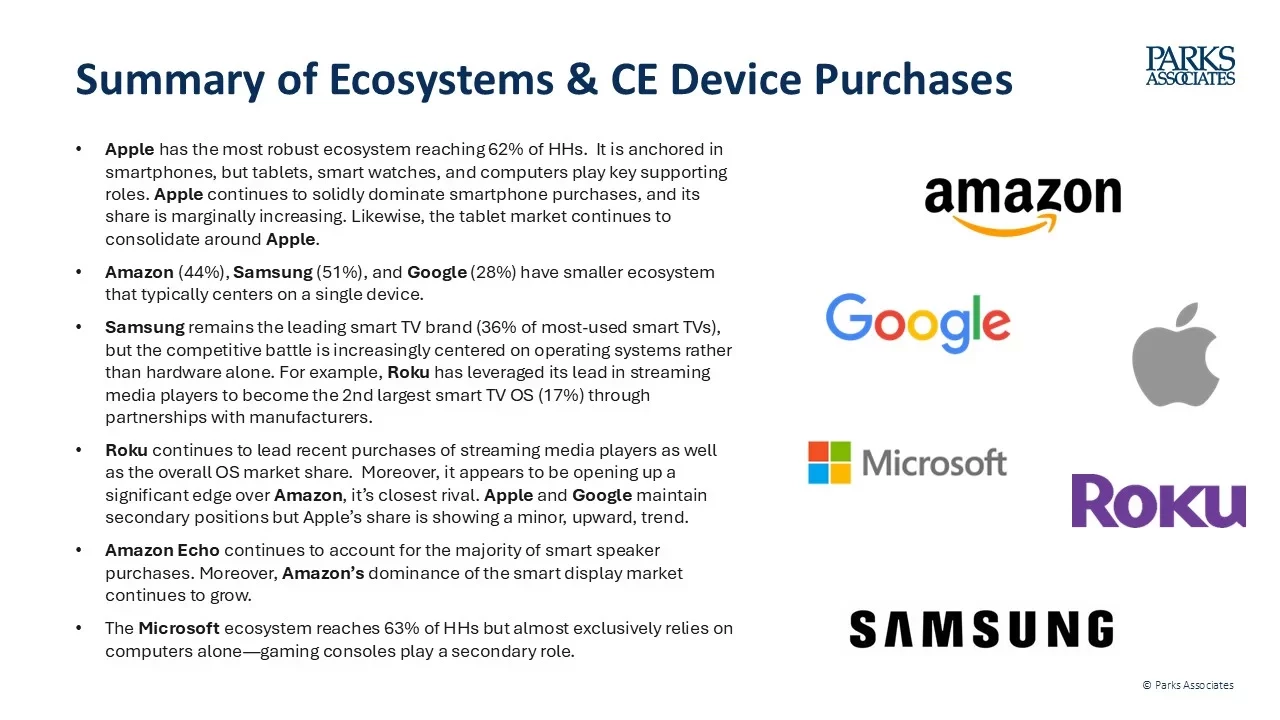
Brand ecosystems are also diverging. Apple has the strongest multi-device ecosystem, with 62% of households owning at least one Apple device and roughly one-quarter qualifying as Apple loyalists by owning three or more Apple devices. Amazon's strength is concentrated in smart speakers, displays, Fire TV, Ring, and Prime-driven household services. Samsung remains strong in smart TVs, smartphones, appliances, wearables, and Tizen, while Google's position is broader but less concentrated, spanning Android, Nest, YouTube, cloud, AI, and automotive.
Data referenced from Parks Associates, Tech Ecosystem Dashboard, Q1 2026
The Tech Ecosystem Dashboard helps companies see which devices are becoming control points, which categories are slowing, where replacement cycles are creating opportunity, and which brands are building stronger ecosystem loyalty. For device makers, service providers, platforms, retailers, utilities, insurers, and home service companies, these insights help identify where to compete, where to partner, and where consumers need a better experience.
Consumer Insights Dashboards present survey-based consumer research that tracks movement of foundational market metrics, such as product or service adoption, household spending intentions, churn, and key tracking metrics on leading industry players.
Parks Associates surveys 8,000 U.S internet households every quarter, with additional surveys fielded throughout the year. The households surveyed represent the national demographics for US internet households, 91% of all US households.

