
According to Parks Associates research, consumers are paying an average of $55.70 per month for home security services, even as affordable DIY systems and standalone cameras give households more options than ever before. What makes consumers willing to pay a premium for professional security?
Our research shows demand for premium smart security experiences that deliver comprehensive protection, an integrated device experience with a unified point of control, and professional services that create value beyond basic alarm monitoring.
For security providers, these premium offerings create opportunities to grow recurring monthly revenue (RMR) while building deeper customer relationships. Consumers increasingly expect security solutions to deliver convenience, control, and protection through a unified platform and with a variety of devices across home ecosystems.
Parks Associates research from Home Security in Transition: The Future of Protection,” a study of 8,000 US Internet households, shows:
- 47% of U.S. internet households have a home security solution.
- Approximately one-third of households own a security camera or video doorbell, creating new entry points into the home security market.
- 35% of U.S. internet households pay for a smart home service, highlighting recurring revenue opportunities.
- 27% of security system owners owned a camera or video doorbell before acquiring their security system, demonstrating how standalone devices can lead consumers toward comprehensive protection.
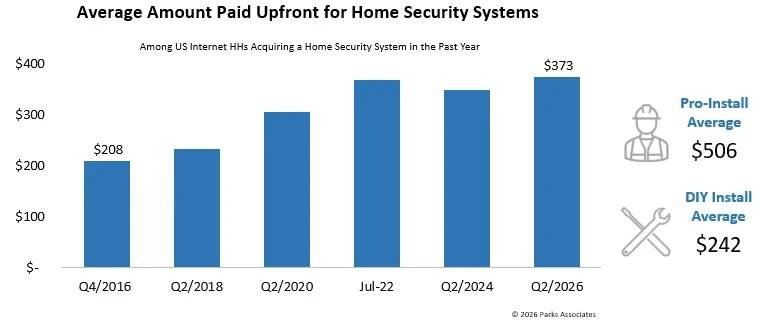
- Average upfront spending on security systems reached $373 in Q2 2026, with professionally installed systems averaging $506 compared with $242 for DIY installations.
Pro Install, Pro Monitoring Segments have Highest Satisfaction, and Investments
Parks Associates research shows that Brinks Home, Vivint, and ADT are all able to command average RMR of $60/month or higher, compared to an industry average of $55.70, while Ring and SimpliSafe consistently fall under the average.
The spread in monthly spending by subscriber base points to an important dynamic in the home security industry: the ability of professional security providers to build higher-value customer relationships through comprehensive equipment packages, professional installation, monitoring, and ongoing services.
While low-cost DIY solutions have expanded the addressable market for home security, professionally installed and professionally monitored systems continue to serve an important customer segment. These households are willing to make a greater investment in home protection, convenience, and professional support.
For the security industry, pro install, pro monitoring allows a broader set of capabilities and services that create value for consumers, increase recurring monthly revenue (RMR), and strengthen long-term customer relationships.
A premium segment in an increasingly diverse security market
The home security market has expanded significantly beyond its traditional customer base. Parks Associates research finds that 37% of US internet households owned a home security system in Q2 2026, up from 31% in 2022. Another 12% own a smart camera or video doorbell without also owning a security system.
Consumers now have multiple pathways to protecting their homes, from standalone cameras and self-monitored systems to fully integrated, professionally supported solutions.
These offerings address different consumer priorities and price points. DIY systems appeal to households seeking affordability, flexibility, and direct control over installation and monitoring. Professionally installed and monitored solutions offer a different proposition: a comprehensive system designed for the home, installed by professionals, supported by ongoing service, and backed by professional intervention when an emergency occurs.
These distinctions are also reflected in consumer spending.
Parks Associates finds that average upfront spending on home security systems reached $373 in Q2 2026, which has increased substantially over the past decade as consumers add more devices to their systems. In 2016, the average upfront amount paid was just $208.
Professionally installed systems averaged $506, more than twice the $242 reported for DIY-installed systems. Frequently, the cost of these higher-priced packages are incorporated into the monthly bill until hardware is paid off, or as a part of the contract for a defined period of time. Consumers choosing professional installation are making a substantially greater upfront investment, whether through direct purchases, financing, or service packages.
Importantly, the business models also differ. Among owners of professionally installed systems, almost half report that equipment was included with a service contract or subscription, compared to approximately one-fifth of DIY-installed system owners.
This packaging approach helps make comprehensive systems accessible while establishing an ongoing service relationship. It also demonstrates why monthly spending cannot always be interpreted as the cost of monitoring alone.
For premium security providers, the customer relationship begins with the installation but extends through years of monitoring, maintenance, equipment upgrades, and additional services.
Higher RMR comes from richer service packages
One of the clearest findings from Parks Associates' Security Dealers Perspectives: Views from the Front Line is the direct relationship between the breadth of a security service package and its recurring monthly revenue.
Dealers report progressively higher monthly fees as service packages expand beyond basic professional monitoring to include interactive capabilities, smart home devices, video storage, and video verification.
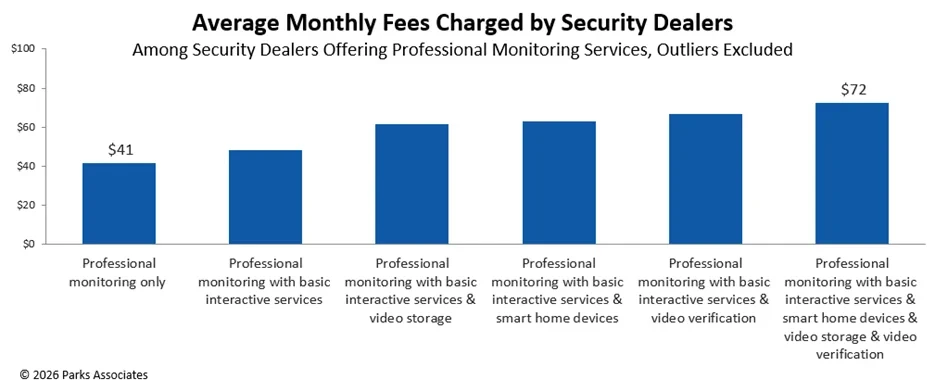
In Parks Associates latest security dealer research, dealers report basic professional monitoring averages ~ $41 per month, while the most comprehensive packages reach $72 per month. That represents a $31 monthly premium for offerings combining professional monitoring, interactive services, smart home capabilities, video storage, and video verification.
For dealers, the implications are substantial. A $31 monthly difference represents $372 in additional annual recurring revenue per account, or $372,000 annually across a portfolio of 1,000 accounts, before accounting for costs, churn, or differences in customer tenure.
The additional revenue is tied to tangible capabilities that expand the value of the system:
- Video storage and intelligence provide access to recorded events, searchable video, and increasingly sophisticated detection capabilities.
- Video verification helps monitoring professionals assess alarm events and provides additional information to support emergency response.
- Smart home integration connects security with everyday household activities, including access control, lighting, thermostats, and garage doors.
- Professional support reduces the burden on consumers to install, configure, troubleshoot, and maintain an increasingly complex connected system.
These capabilities transform a security system from a standalone alarm into an integrated home protection and management platform. The highest-value accounts are those purchasing a broader combination of technology and professional services.
Video and smart home integration are redefining premium security
The equipment included in a home security system is also changing. Parks Associates finds that cameras are included in more than half of security systems acquired within the past year, compared to over a third of systems acquired more than six years ago. Smart door locks show an even larger difference, appearing in more than a quarter of the newest systems versus under 10% of systems acquired more than six years ago.
Meanwhile, traditional security panels are becoming less central to the equipment package. Less than half of systems acquired within the past year included a security panel or keypad, compared to systems acquired more than six years ago, where a security panel was common.
The evolution reflects a fundamental change in consumer expectations. Consumers want to see what is happening around their homes, manage access remotely, get relevant alerts, and have security integrated with other devices.
Dealers are seeing these priorities firsthand. In Parks Associates' latest dealer survey, a vast majority identify customer demand for cameras and video doorbells as a driver of residential security business, while more than half cite demand for smart home devices such as locks, lights, and thermostats.
Yet it’s a smaller group of surveyed dealers who position themselves primarily as smart home solutions companies rather than premises security companies.
This disconnect represents an opportunity. Dealers already have a trusted position inside the home, installation expertise, and an ongoing service relationship. By expanding their offerings and messaging beyond intrusion detection, they can capture more of the consumer's connected home spending. Video and smart home devices create opportunities to introduce additional recurring services, increase customer engagement, and make the security platform more valuable in everyday life.
Professional services remain a critical differentiator
As cameras, smart locks, and connected devices become more widely available, hardware alone becomes a less sustainable basis for differentiation. Professional security providers have an opportunity to compete on the experience surrounding the technology.
Professional installation helps ensure that devices are properly configured, connected, and positioned to meet the household's needs. Professional monitoring provides an additional layer of protection through trained personnel who can evaluate alerts and initiate appropriate responses.
The value proposition is especially important as systems become more sophisticated. A household with multiple cameras, sensors, locks, and automation features may place considerable value on having a single provider responsible for making the system work reliably.
New services extend this differentiation further. AI-powered detection, proactive deterrence, video verification, and live agent intervention offer opportunities to move beyond traditional alarm monitoring toward more intelligent, responsive protection.
The next phase of security competition: account value, not price alone
The home security industry will continue to serve consumers with different budgets, installation preferences, and protection needs. DIY solutions are expanding the market, while professionally installed and monitored systems remain an important offering for households seeking comprehensive protection and professional support.
The higher monthly spending reported by Brinks Home and Vivint customers should be viewed within this broader market structure. Their positions are consistent with the economics of premium security offerings, where comprehensive systems and service relationships support higher recurring spending.
For dealers and security providers, several priorities will shape future growth: attracting customers seeking comprehensive solutions, expanding equipment and service packages, integrating video and smart home capabilities, and strengthening retention through ongoing value.
The long-term opportunity for professional security is to be the most valuable protection partner for the households it serves, not the least expensive option.
Research methodology and interpretation
The consumer data cited in this analysis comes from Parks Associates' Home Security in Transition: The Future of Protection, based on a survey of 8,000 US internet households conducted June 20–26, 2026. Demographic quotas were established for age, gender, and household income to reflect the US internet household population.
Monthly fee averages are based on security system owners reporting payments for services such as professional monitoring, paid self-monitoring, video storage, or other add-on capabilities. Reported amounts may include multiple services and, in some cases, equipment payments that consumers include in their total monthly bill. Responses below $5 and above $150 per month were excluded. These figures represent consumer-reported monthly spending, not independently verified provider RMR or service-only revenue.
Dealer findings are from Security Dealers Perspectives: Views from the Front Line, based on a separate survey of residential security dealers conducted October 2025–January 2026.