

This is an excerpt from Parks Associates Broadband Tracker Service. The Broadband Market Tracker provides estimates for residential home internet subscribers and ISP revenues for the North American market.
Broadband Market News and Trends
In the fourth quarter of 2025, US residential broadband subscriptions grew by an estimated 984K among the top 30 players, an increase of over 300K from Q4 2024 which added 642K estimated new subscriptions. Parks Associates estimates that as of year-end 2025 home internet penetration has reached 81% of US households overall, and 94.4% of households have access to internet of some kind, with some 13% able to access the internet via a smartphone or tablet but lacking a home internet subscription (mobile-only households).
The majority of the remaining greenfield market for residential home broadband providers are those living in mobile-only households. These households are generally younger, less financially secure, and are much more likely to be smartphone-dependent than current US home internet households. They are likely to lack personal computers, smart TVs, gaming consoles, and smart home devices, which are key drivers of home internet adoption. Only 5% of US households completely lack home internet service, mostly older individuals and those choosing to remain disconnected.
Market Competition
2025 saw 240K more net home internet additions than 2024, with net adds growing from an estimated 2.43M new home internet subscriptions in 2024 to 2.66M in 2025 even in the face of consumer economic concerns. Broadband remains resilient as a non-discretionary expense among US households but faces a growing threat from mobile-only consumers as overall household expenses rise and the cultural impact of the 2020 COVID-19 pandemic begins to fade.
- The remaining greenfield market is concentrated in mobile-only households. Future broadband subscriber growth will increasingly come from mobile-only households rather than completely unconnected homes. Less than 5% of US households lack any internet access; however, 13% rely exclusively on smartphones or tablets for connectivity and do not subscribe to home broadband.
- With gigabit speeds set to become increasingly common, look towards reliability as a differentiator. Service reliability is becoming a significant factor in customer retention and churn reduction, especially for companies operating cable or HFC networks. ISPs are likely to increasingly compete on network resilience features — including backup connectivity, redundant networks, and power-resilient equipment — as competition remains high.
- The DISH Wireless default on tower lease obligations risks knock-on effects throughout the US mobile market. Tower operators are expected to lose between 5-7% of their annual revenues due to DISH’s default and are likely to pass these losses on to carrier customers. Higher infrastructure costs will result in increased operating expenses for MNOs and MVNOs, affecting pricing strategies and network convergence goals.
- Proposed housing regulations will ease shortages and create new demand for broadband service but may harm demand for bulk services. The US House and Senate have introduced and passed separate bills aimed at reforming the US housing market, making it easier and faster to build new housing. The US Senate bill, however, contains several provisions that risk harming the demand for bulk broadband and proptech, namely rules requiring developers to sell build-to-rent properties to individual homeowners after seven years.
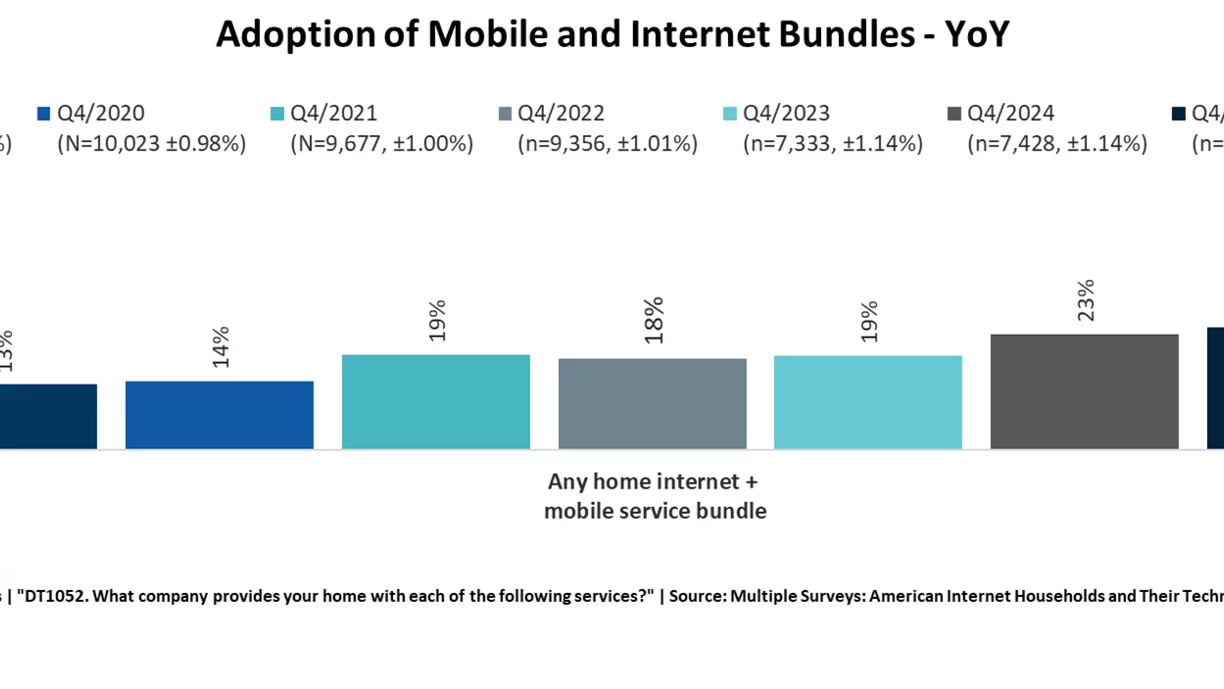
- Convergence is a new battleground. ISPs have been leveraging broadband network convergence with mobility in order to attract and retain subscribers, with additional services — including video and security — adding additional strength to bundles. With mid-sized and smaller holdouts in the US market looking towards MVNO agreements, the strength of a mobile offering has become key.
This is an excerpt from Parks Associates Broadband Tracker Service. Also included is data from our Home Services Dashboard. The Broadband Market Tracker provides estimates for residential home internet subscribers and ISP revenues for the North American market. Complete this form to request more information and pricing for this new service.
Parks Associates Broadband Market Tracker provides estimates for residential home internet subscribers and ISP revenues for the North American market, including for those that do not publicly release figures. This service provides estimates of the growth of MNO fixed wireless service and fiber network composition, as well as detailed profiles of market leaders. It also includes quarterly insights reports assessing key market trends, competitive moves, partnerships, and new product offerings.
Estimates and Profiles – Accompanying Excel Deliverable
- Detailed profiles of 25+ residential internet providers in the US and Canada
- Estimates of residential home internet subscriptions and revenues of leading players
- Breakout estimates of MNO fixed wireless service
News and Analysis
- Strategic assessment of market changes, current announcements, and new products
- Insights into strategies of key players
- Evaluation of events in the context of broader market trends and the competitive landscape
- Identification of market, partnership, and revenue opportunities
- Special coverage of the multifamily housing market

