

The Carrier roundtable and breakfast briefing held last week at DistribuTECH focused on how utilities and industry partners can respond to rapid load growth driven by data centers, electrification, and AI. Speakers emphasized that traditional planning cycles and infrastructure investments alone cannot keep pace. Near-term solutions must combine customer-side flexibility, distributed storage, and new program designs that work at scale.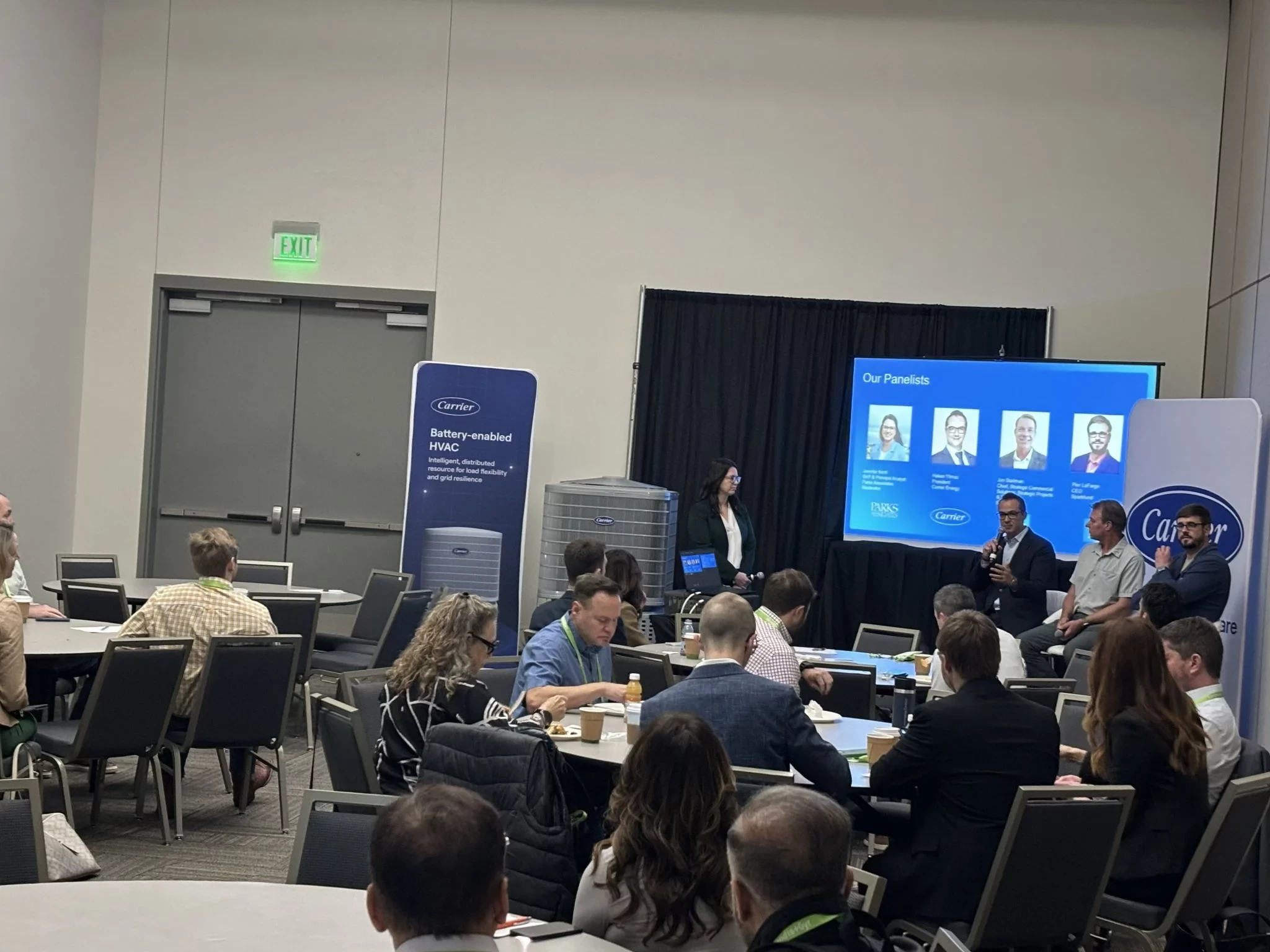
The session was moderated by Jennifer Kent, SVP and Principal Analyst, Parks Associates and featured executives from Carrier Energy, PG&E, and Sparkfund.
Hakan Yilmaz, President, Carrier Energy & Chief Sustainability Officer, Carrier, opened with the perspective that the built environment has long taken energy for granted. That assumption no longer holds. HVAC is now one of the most important grid assets. It represents the third-largest household expense and one of the most significant contributors to peak demand. Residential HVAC loads are highly coincident and create sharp peaks that stress local distribution systems. With one in three U.S. homes using Carrier equipment, HVAC fleets can offer a meaningful opportunity for flexibility.
Yilmaz noted that traditional thermostat-based demand response programs are reaching their limits. HVAC is a comfort-critical asset and an expensive investment for homeowners. Programs that rely on cycling equipment off can create friction and limit participation. Carrier’s view is that the future lies in variable-speed, connected HVAC systems paired with on-site storage. Battery-enabled HVAC can smooth peaks without compromising comfort. Open APIs and embedded intelligence allow systems to respond automatically and at speed. Over time, AI-driven control can move HVAC from basic automation to autonomous operation that supports grid needs continuously.
Jon Stallman, Strategic Commercial Solutions, PG&E described the scale of the challenge facing utilities. PG&E is managing roughly 15 gigawatts of new load growth, the fastest increase in decades. Much of this growth comes from large data centers that require high-voltage connections and long lead times for substations and transmission upgrades. Building new infrastructure can take five to seven years. That timeline does not align with customer demand. While wires and generation remain essential, utilities need faster options that work within existing constraints.
Stallman emphasized the importance of working both in front of and behind the meter. Batteries are especially valuable because they are dispatchable and can respond quickly during grid stress. Aggregation through virtual power plants can help, but utilities must still navigate operational requirements and regulatory frameworks. Near-term flexibility is critical while long-term infrastructure is built.
Pier LaFarge, CEO of Sparkfund, framed the problem as one of optimization rather than shortage. Capacity constraints often exist only during peak hours. If utilities can move energy into periods with available headroom, reliability improves and costs decline. LaFarge pointed to three essential pillars for addressing load growth. These are batteries, demand response, and grid-enhancing technologies. AI enables coordination across these assets and helps utilities place resources where they deliver the most value.
HVAC + Storage: Building Dispatchable Capacity at Scale
Parks Associates and Carrier released a new white paper at the event, Demand Response for All: Scaling Capacity & Flexibility, shows that HVAC-centered demand response is one of the most practical ways to unlock flexible capacity at scale. Most households still lack advanced energy technologies. Only 17 percent of U.S. internet households own solar, batteries, EVs, or smart electrical panels. This leaves roughly 104 million households without these systems, making HVAC a critical entry point for participation.
Awareness remains a major barrier. Twenty-eight percent of non-participants have never heard of a demand response program. Twenty-five percent do not believe their utility offers one. Churn is also a challenge, with 12 percent of previously enrolled households no longer participating.
At the same time, consumer interest is strong. Fifty-two percent of single-family homeowners find advanced HVAC service concepts appealing. Seventy-four percent of households find at least one benefit of home battery solutions appealing. Fifty-five percent of households are interested in charging batteries when energy is inexpensive and using stored power when prices are higher.
HVAC paired with storage can evolve from a niche demand response tool into reliable, dispatchable capacity. Achieving this will require new program designs, faster regulatory alignment, and closer coordination between utilities, manufacturers, and technology providers.