

On March 5, 2026, Parks Associates kicked off its first Smart Energy Summit virtual session of the year with a timely discussion on how the industry can better empower the energy ecosystem through data, engagement, resilience, and grid flexibility. This session brought together Parks Associates analysts and industry leaders to examine the technologies, partnerships, and market shifts shaping the future of distributed energy resources (DERs), demand response, home energy management, and grid orchestration.
We are grateful to this year’s Smart Energy Summit sponsors: SkyBell, Carrier, Johnson Controls, Smart Energy Consumer Collaborative, Silicon Labs, and Vivint, an NRG company. Their support helps make these important industry conversations possible.
The session opened with Parks Associates research highlighting a growing pressure point for consumers: rising electricity costs. As monthly electricity bills continue to climb, energy affordability is becoming an increasingly pressing issue across income brackets and household sizes. That pressure is creating new opportunities for energy providers, device manufacturers, and service platforms to show consumers how smart energy solutions can deliver real savings. Parks Associates shared data showing renewed interest in products such as smart thermostats, solar panels, and home battery storage, even as barriers like cost and complexity still limit broader adoption.
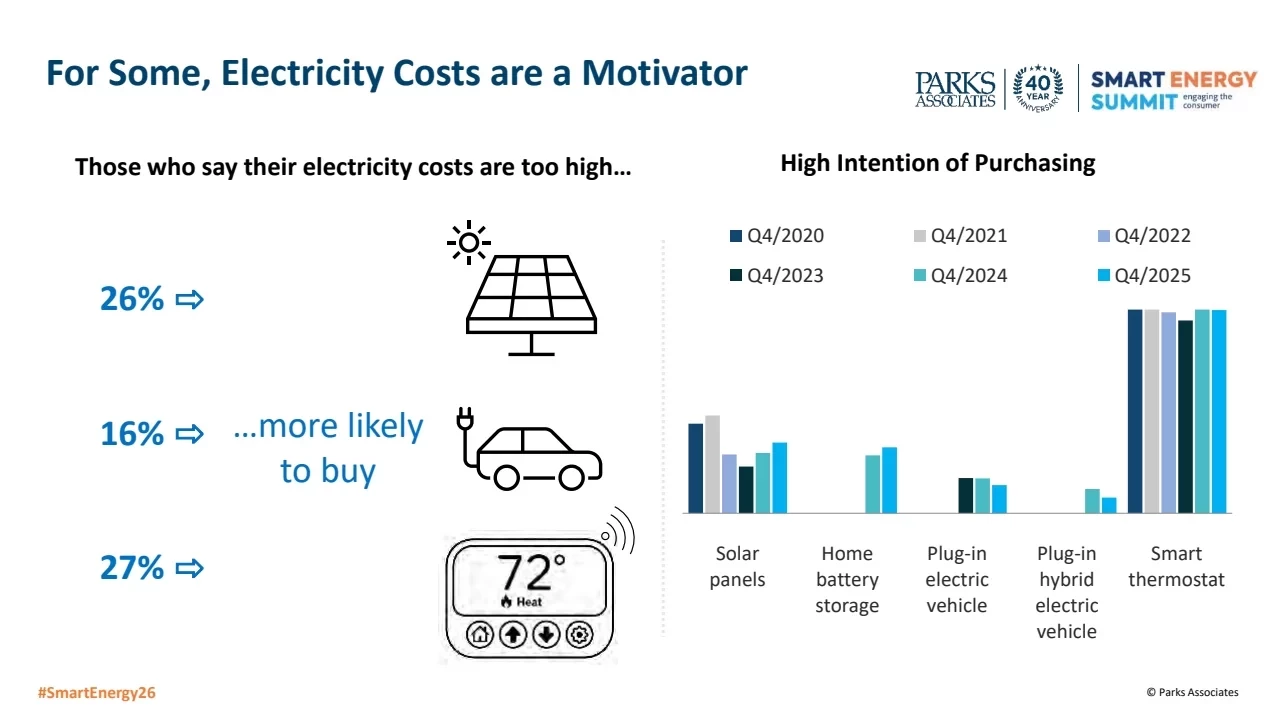
The takeaway was clear: consumers want lower bills, but the industry must do a better job of connecting product value to long-term savings.
A major focus of the session was the role of distributed energy resources in delivering both consumer value and grid flexibility. Parks Associates analysts explored how utilities and solution providers can better engage households through demand response programs, time-of-use offerings, and connected device orchestration.
At the same time, the market still has significant room to grow. Many households have never participated in an energy program, and many consumers remain unfamiliar with how these programs work or how connected devices can help. Speakers emphasized that adoption starts with making the first step easier. For many consumers, that first step is not a solar installation or EV purchase. It is more likely a smart thermostat or another smaller connected device that can introduce automation, energy savings, and participation in grid programs without a major upfront investment.
Register for the next session on August 20.