The AI market is moving beyond the growth-at-all-costs phase. For the past few years, providers have focused on attracting as many users as possible, offering free access while absorbing the costs of running the models. That strategy helped drive awareness and gave consumers a low-risk way to try generative AI, build familiarity with it, and start using it in their personal and professional lives.
We are now at a different point in the market. Parks Associates research finds 63% of consumers in US internet households use a generative AI tool for personal, professional, or educational purposes, and another 17% are familiar with these tools but do not use them. Awareness is well established, and usage has reached a large share of the market.
At the same time, running increasingly powerful models is expensive. Consumers expect better reasoning, multimodal capabilities, image and document analysis, and AI agents that can complete more complicated tasks. Providers are under pressure to support that growing use while building businesses that can support the costs.
As a result, we are seeing much more attention on monetizing the AI user base.
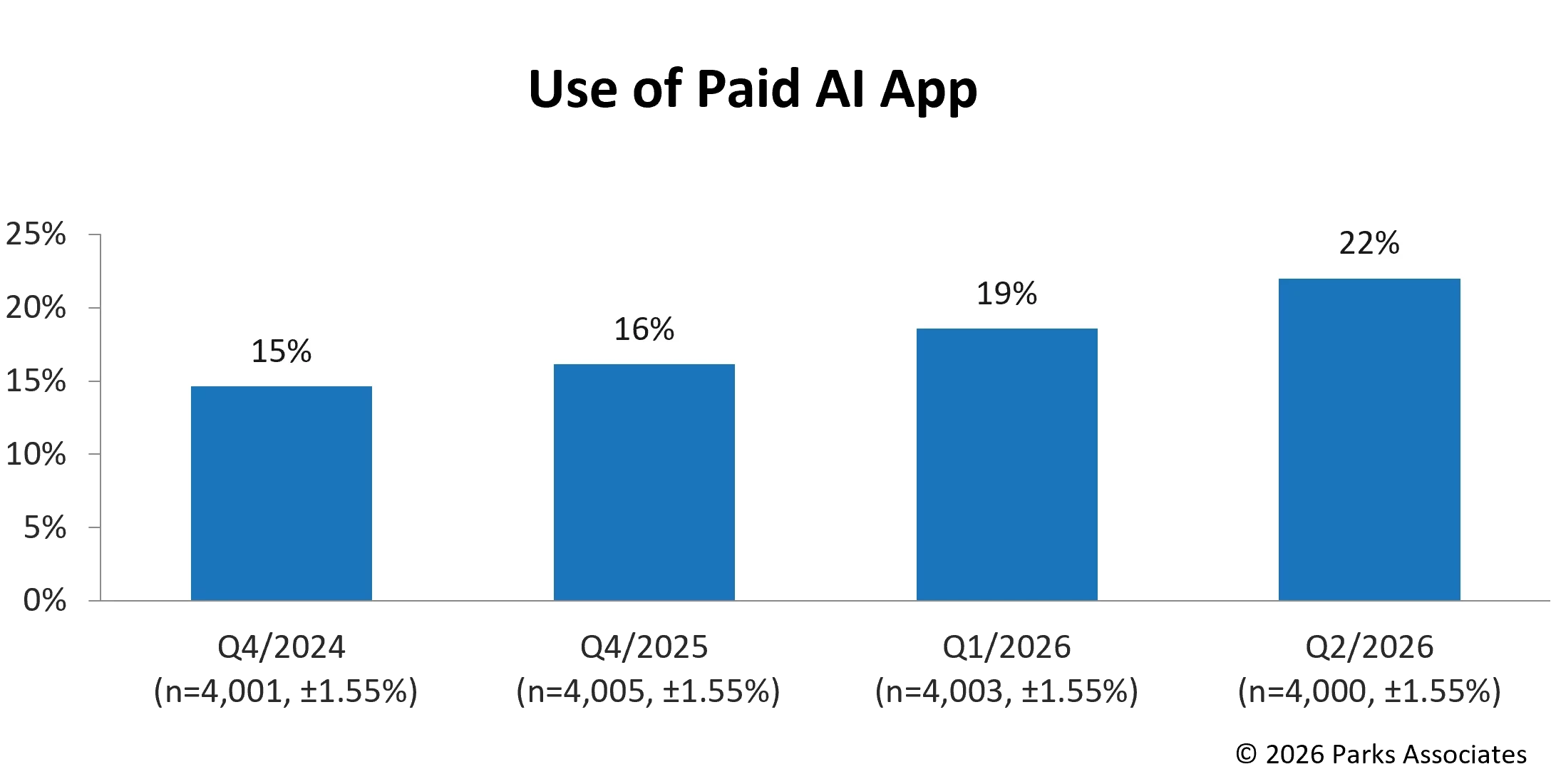
As of Q2 2026, 22% of consumers in US internet households report using a paid version of a generative AI tool, up from 15% in Q4 2024. Some consumers may have access through an employer rather than paying for the subscription themselves, but the increase shows that paid AI is reaching a larger part of the market.
AI providers are testing a much wider range of prices
One of the most interesting things happening now is the range of pricing models being tested. Earlier this year, Google and OpenAI introduced plans around the $8 per month price point, giving consumers another option between free AI and the $20 subscriptions that have been common in the market.
At the other end, the ceiling has gone much higher. AI providers are offering plans reaching $100-$200 per month, aimed at creators, developers, consultants, and professionals who use these tools frequently enough to get much more value from them.
Pricing is also becoming more connected to how much AI a person uses. As AI agents take on more complex tasks, every task does not require the same level of computing power. Providers are differentiating plans based on compute resources, reasoning capabilities, context length, and usage.
We are seeing several approaches take shape:
- Free services that bring consumers into the ecosystem and help them develop regular AI habits
- Mainstream subscriptions around $20 per month that remove many of the limits of free services
- Higher-priced plans for heavy users who rely on AI every day for professional or creative work
- Bundles that combine AI with other digital services
- Usage or transaction models that could eventually charge based on what the AI successfully completes
The market will likely support multiple models. We have seen this before in streaming, where subscription video, advertising-supported services, pay-TV packages, and hybrid models all serve different users and different needs. AI is likely to develop in a similar way, with providers using different packages depending on who they are trying to reach and what those users are trying to accomplish.
Bundling can help consumers understand what they are paying for
Google offers a useful example of how AI may become part of a larger digital package. Its AI plans combine Gemini with services consumers already know, including Gmail, Docs, Drive, Photos, YouTube, cloud storage, and connected home services.
That gives Google a different way to make the case for a higher monthly price. The consumer is not being asked to put a value on an AI assistant alone. The AI sits within a package of productivity, entertainment, creation, storage, and other services that already have recognizable value.
Other AI companies do not have Google's collection of consumer services, so we could see more partnerships between AI providers and companies across consumer technology, entertainment, connectivity, and other services. Those partnerships could help providers build packages around how consumers actually use technology rather than selling AI as a standalone product.
We may also see more pricing based on completed tasks. Instead of paying based on prompts, tokens, or another technical measure that means very little to most consumers, a user could pay for AI that successfully books a trip, completes a financial task, or creates professional-quality content. The more AI moves from answering questions to doing things on behalf of users, the more important this type of model could become.
Consumers see more value in AI, but concerns remain high
Our consumer research shows gradual improvement in how people view the value of AI. In Q2 2026, 48% of consumers said AI search results and information are useful and accurate, while 47% said they feel they must use AI to stay relevant. We are also seeing increases in the percentage who believe AI has had a positive impact on their personal or professional lives.
We have even seen some improvement in consumers' response to products advertised as including AI. Still, more consumers overall say the presence of AI would make them less likely to buy a product than say it would make them more likely. The results can look very different when we ask about a specific product or use case, which is why companies need to be careful about treating AI itself as the value proposition.
There is another issue that has not improved with growing use: consumer concern.
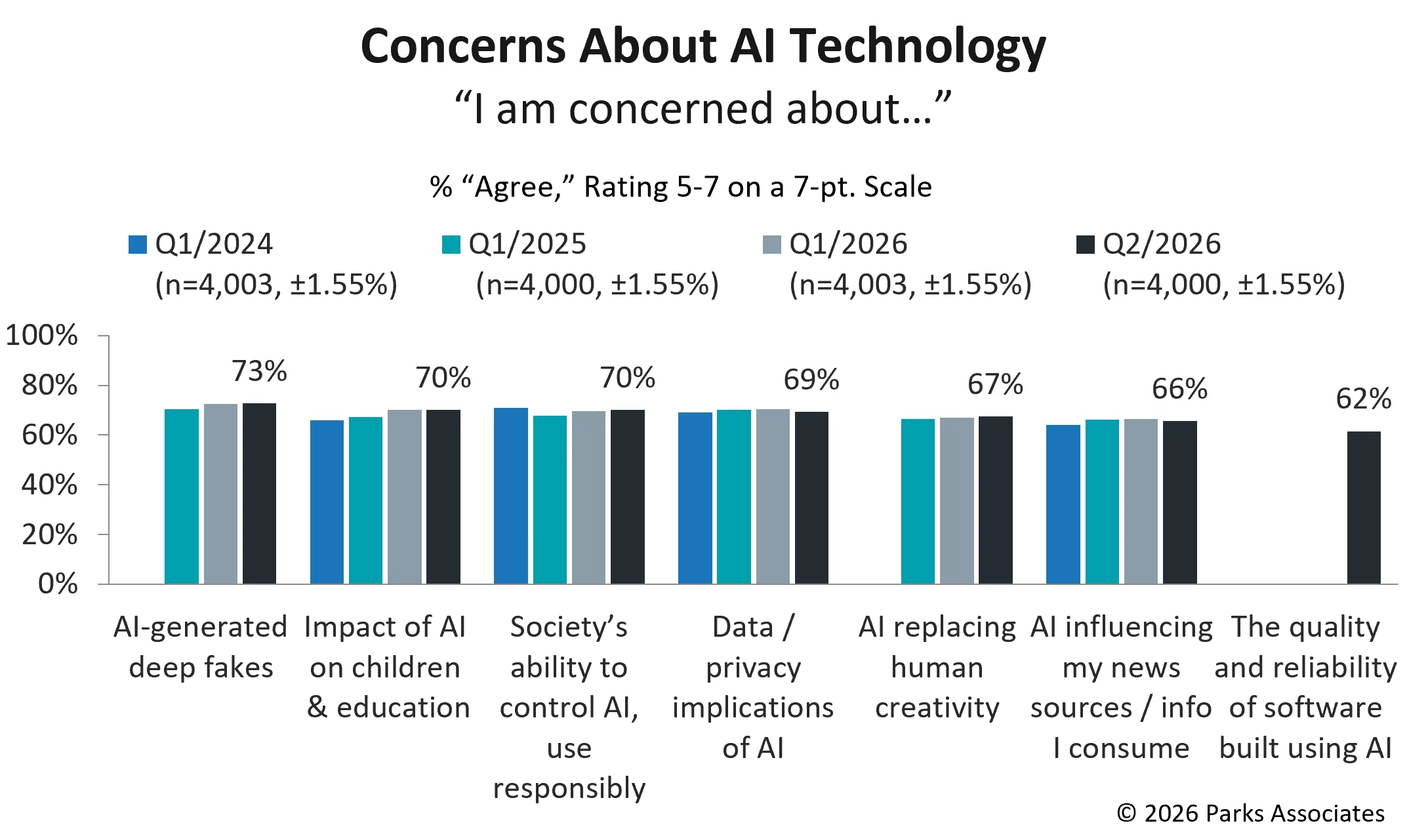
More than 60% of consumers remain concerned about AI-generated deepfakes, society's ability to control AI and use it responsibly, data privacy and security, AI replacing human creativity, and AI influencing news sources. Concern about the impact of AI on children and education is getting higher. These concerns have remained at high levels even as more consumers use AI and report getting value from it.
For companies adding AI to consumer products and services, trust has to be part of the product strategy. It cannot be assumed that familiarity alone will make consumers more comfortable with the technology.
Health shows what happens when the use case is clear
Health is one area where consumers are already finding ways to use AI for needs they understand. Parks Associates research finds 73% of consumers in US internet households have asked an AI tool a health-related question. Consumers are using these tools for general health information, symptom checking, nutrition guidance, fitness advice, medication side effects, and mental health information. Some are going further and using AI to help understand a diagnosis, lab result, or other health document.
There is a strong opportunity here for older consumers as well. The connected health market already has devices, monitoring services, and remote patient monitoring solutions collecting different types of information. AI can help make that information easier to understand and allow consumers to ask questions in a more natural way.
Among AI users age 55 and older, 60% have used AI for health-related questions. We also find that older consumers show strong interest in AI-enabled emergency assistance on wearables, even though their interest in many other technology features tends to be lower than that of younger consumers.
These use cases point the way to real AI opportunities. The goal is not to add AI everywhere or make AI the headline for every new product. Companies must identify where it makes an existing product or service more useful, helps consumers understand information, reduces work, or solves a problem they already have.
Consumer use of AI is established and paid use is growing. The next phase will see companies experimenting to find the right combination of price, packaging, and applications that consumers believe are worth paying for. Companies that can show that value while maintaining consumer trust will have the strongest opportunity to turn today's AI usage into a lasting business.
Parks Associates tracks consumer AI use and preferences quarterly in its Consumer Insights Dashboard: AI Experience. Request more information here.