
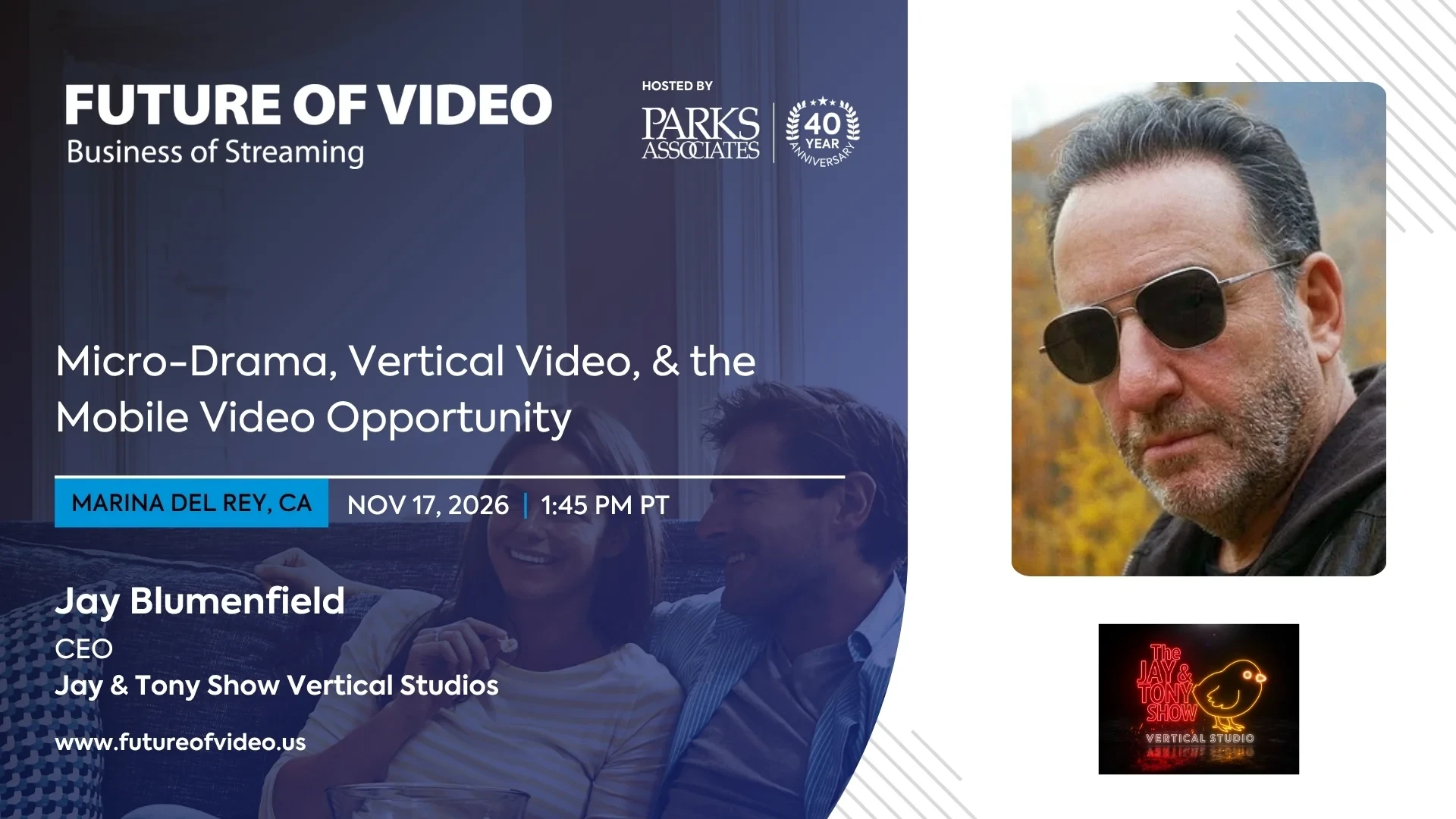
 We are excited to welcome Jay Blumenfield, CEO of Jay & Tony Show Vertical Studios, to Future of Video for “Micro-Drama, Vertical Video, & the Mobile Video Opportunity” at 1:45 PM PT. Moderated by Elizabeth Parks, the session brings together leaders from Vert-I-Go Media, GoodShort, and Pocket FM to explore how mobile storytelling is creating new opportunities for audience growth and monetization. Ahead of the discussion, Jay shares his perspective on the evolution of micro-dramas and what media executives should understand about this emerging category.
Ahead of the discussion, Blumenfield shares his perspective on the changing television landscape, the emergence of mobile-first intellectual property, the economics of vertical production, and the role of AI in the future of entertainment.
1. Industry Trends
What is the biggest shift impacting your company, and how will it impact the market over the next 2–3 years?
Jay - The death of the television business as we knew it. And increasingly, the death of Hollywood as the place where Hollywood actually gets made. We get pitched television shows all the time that would have been slam dunks five years ago. Today we usually pass. Not because the ideas aren't good, but because who the hell are we going to sell them to? When aspiring reality stars come to us, my advice these days is usually: Get your phone out, film yourself, and start a YouTube channel. Don't wait around for someone at a network to decide you're interesting. I think over the next few years we're going to see a whole new way of making, financing, and distributing entertainment emerge. Some of it is going to be completely unrecognizable to those of us who grew up in traditional television. And some of it will look remarkably familiar. Because at the end of the day, people still want great stories, interesting characters, and something they can't stop watching. We're just figuring out a whole new way to give it to them.
2. Business Growth
Name two areas where you see the greatest opportunities for revenue growth, profitability, and innovation in streaming.
Jay - First, mobile-first IP. And I don't mean taking an old television show, cropping out half the picture, and calling it vertical. I mean stories that are conceived, written, shot, and consumed specifically for a phone. I think some of the next big film franchises, television series, and graphic novels are going to start as vertical microdramas. The phone isn't just another way to watch content. It's becoming a place where valuable new IP is born. Second, blowing up the economics of production. We've spent decades making television one way, with enormous crews, long schedules, and budgets that often seem designed to make sure nobody ever makes their money back. We've now produced scripted vertical series on multiple continents, shooting what amounts to an entire season in six or seven days. Five years ago, I would have told you that was impossible. Now I can tell you exactly how to do it. That doesn't mean everything should be made cheaply. But it does mean we need to rethink what things actually have to cost. The opportunity isn't just making cheaper television. It's creating an entirely different business where the economics actually make sense.
3. AI & Technology
Name two or three ways AI or emerging technology is changing the way your company approaches content, advertising, distribution, or audience engagement?
Jay - AI is going to make it possible for just about anybody to make a television series. Which is great, except that doesn't mean anybody is going to want to watch it. We're already experimenting with AI in production and post, and the possibilities are pretty extraordinary. But I think everyone is so obsessed with how cheaply we can make content that we're missing a bigger question: Who's going to watch all this stuff? When anyone can make a show, making a show isn't particularly special anymore. I actually think discovery and marketing are going to become as important as production, maybe more important. AI will help us create content, but it should also help us figure out who wants to see it and how to reach them. We're heading into a world with almost unlimited content and exactly the same number of hours in the day. That's a pretty interesting business problem.
4. Consumer Engagement
What are the biggest challenges in engaging consumers with video content? What strategies are proving most effective?
Jay - People have no problem watching video. They're watching it constantly. The problem is getting them to watch yours. In traditional television, you had an entire pilot to convince somebody to come back next week. In vertical, you might have three seconds before someone's thumb decides your fate. And weirdly, I love that. It's forcing us to rethink how we tell stories. We've learned that the first 20 episodes of a 60-episode micrdrama can be more important than the remaining 40. Every scene needs to earn its place. You need to establish characters, create tension, and make people genuinely desperate to find out what happens next. Everybody talks about cliffhangers in vertical, but a cliffhanger only works if somebody actually cares whether the character falls off the cliff. The technology changes. The length changes. The screen changes. But the reasons people fall in love with stories haven't changed much at all.
5. Future Outlook
What significant changes do you expect to see in the next 12 months in the media and entertainment industry?
Jay - I think we're going to see a real separation between people who understand where entertainment is going and people who have just added "AI" and "vertical" to their company descriptions. The most valuable creative person in the next few years is going to be a strange hybrid. Someone who understands traditional television, knows how to tell a story, knows how to run a set, but also respects mobile-first entertainment enough to throw out everything they know that doesn't work anymore. And that's harder than it sounds. I've spent more than 30 years making television. A lot of what I learned has been incredibly useful in vertical. A lot of it I've had to unlearn. You can't just turn a television sideways and expect it to work. You also can't throw out 100 years of storytelling because somebody invented a new screen. The trick is figuring out what to keep and what to leave behind. And frankly, after 30 years in this business, it's pretty exciting to be doing something where nobody has all the answers yet.
Join the Discussion at Future of Video
Jay Blumenfield will join leaders from Vert-I-Go Media, GoodShort, and Pocket FM for “Micro-Drama, Vertical Video, & the Mobile Video Opportunity” at 1:45 PM PT at Parks Associates’ Future of Video conference. Moderated by Elizabeth Parks, the discussion will examine the business opportunities emerging from mobile-first storytelling, the evolution of vertical video, and new approaches to content production, distribution, audience engagement, and monetization.
Join Parks Associates on November 17–18, 2026, in Marina del Rey, California, for Future of Video: Business of Streaming, and hear from industry leaders exploring what comes next for the video business.