
ADT has announced the acquisition of Origin Wireless (operating as Origin AI) to integrate its AI sensing platform into ADT’s security and smart-home ecosystem, and it concurrently unveiled a long-term commercial agreement with Verisure to scale that AI-driven sensing technology across millions of professionally monitored homes.
Below is a summary of the news releases:
ADT Acquires Origin AI to Power AI Sensing and Ambient Intelligence for the Home (Feb. 24, 2026) - read full release
- ADT Inc. agreed to acquire Origin Wireless, Inc. (doing business as Origin AI), bringing its AI sensing technology and related IP into ADT’s portfolio.
- Origin’s technology enables motion classification and human detection without cameras, audio, or wearables, using advanced AI sensing.
- The acquisition includes over 200 global patents and is intended to create a core intelligence layer for future security and smart home applications, including aging-in-place and occupancy insights.
- ADT expects to commercialize integrated offerings leveraging this technology beginning in 2027.
- The purchase price was $170 million in cash, subject to customary adjustments.
- Leadership highlights the opportunity to elevate traditional security with context-aware sensing, reduce false alarms, improve responder coordination, and enhance personal privacy.
ADT, Origin AI, and Verisure Sign Long-Term Commercial Agreement to Scale AI-Driven Security (Feb. 24, 2026) – read full release
- ADT, Origin AI, and Verisure entered a five-year renewable commercial agreement for Verisure to license Origin AI’s proprietary sensing technology following the acquisition.
- Verisure has been using Origin AI’s sensing tech for five years and was a minority investor in Origin since 2023.
- The agreement expands Verisure’s rights to deploy the AI sensing platform across its European and Latin America customer base, including applications for aging technology.
- Key features include defined exclusivity in professionally monitored security markets, ongoing development collaboration, and data sharing to enhance AI models.
- The deal is valued at $30 million over five years for development services plus per-household activation fees.
- The AI sensing capabilities support verified human presence detection, improved alarm verification, fewer false alarms, and expanded occupancy-based use cases.
This is a significant acquisition for a number of reasons. Parks Associates has tracked the evolution of the residential security market for decades, and what was once a hardware-centric, intrusion-focused category has matured into a services-driven platform business. The market is no longer defined solely by professional monitoring. The security market is expanding to deliver higher-value services, deeper data insights, and tighter integration across the connected home ecosystem.
ADT’s acquisition of Origin AI reflects this next phase of transformation. This type of camera-free AI-fueled ambient intelligence adds a new contextual layer to security systems. Instead of reacting to discrete sensor trips, providers can interpret presence, movement patterns, and occupancy in real time using WiFi sensing. That shift enables:
- More accurate alarm verification and reduced false alarms
- Enhanced emergency response coordination
- Privacy-forward monitoring alternatives to cameras
- Expansion into adjacent use cases such as aging-in-place, wellness monitoring, and energy optimization
- Deeper integration with smart home devices and automation platforms
The parallel long-term agreement with Verisure further reinforces that this is not just a technology tuck-in, but a platform strategy. Scaling AI sensing across large, professionally monitored subscriber bases accelerates data refinement, recurring service innovation, and differentiation in an increasingly competitive global market.
From a broader industry perspective, this move underscores a structural shift: security providers are becoming whole-home intelligence platforms. The opportunity is no longer limited to protecting entry points: it now encompasses delivering continuous, context-aware services that drive recurring revenue, improve customer stickiness, and expand lifetime value across the connected home.
Research from Parks Associates shows that security solution and service adoption is at an all-time high as consumers embrace both systems and device-based services.
From 2022 to 2025, ownership of security systems grew modestly, while device-only adoption doubled, showing how consumers are expanding their entry points into the security market. Paid service adoption also increased, with households increasingly attaching subscriptions not only to systems but also to individual devices.
This growth reflects a broadening monetization opportunity for the industry as consumers seek flexible, affordable approaches to protection, and see security systems as key providers of home automation.
Research highlights from Parks Associates' study Next Gen Home Security: Competition, Innovation, New Services:
- 48% of U.S. households had a security solution in Q2 2025, up from 38% in July 2022.
- Security system ownership rose from 31% (2022) to 34% (2025), while device-only adoption grew from 7% to 14%.
- 35% of households subscribed to a paid security service in 2025, up from 30% in 2022.
- Paid services tied to devices grew from 5% in 2022 to 9% in 2025, signaling stronger demand for subscription-based device protection.
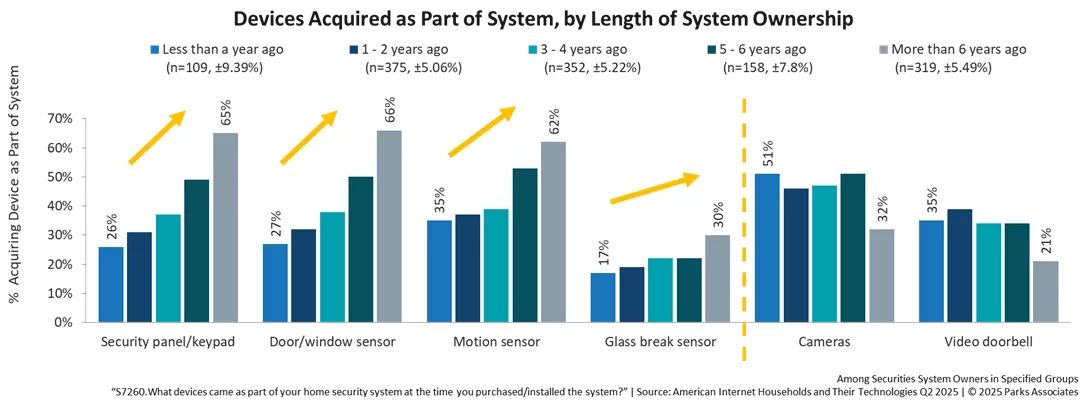
Security system hardware packages are changing. Video leads in today’s systems whereas panels and sensors compose the core of older systems. Legacy systems were anchored by discrete sensors like panels, motion detectors, and glass-break devices, but these categories show declining demand in newer installations. Video products are taking the lead, not only as primary monitoring tools but also as multi-functional sensors, with analytics enabling motion, person, and package detection without separate hardware.
System providers must adapt portfolios accordingly, emphasizing video devices and software-driven intelligence while treating traditional sensors as embedded features or complementary rather than core system drivers.