Apple’s latest Apple Watch announcements show how quickly the battle over consumer AI is moving beyond the smartphone and browser and onto the body. With the #1 smart watch offering in the US, Apple is pressing its advantage in health features to provide practical reasons consumers embrace AI wearables.
Apple Watch Series 12 and Ultra 4 introduce a new Health Sensing System with higher-frequency heart rate and HRV measurements, a readiness score, and deeper integration with a redesigned Health app. At the same time, Apple Intelligence is moving directly onto the wrist. Siri AI brings personal context and broader knowledge, while new Audio Intelligence features including Sound Recognition, Live Rewind, and Siri Recap can recognize important sounds and help users recall moments from everyday conversations.
Today, however, the smartwatch is still a secondary AI interface. Parks Associates’ Consumer Insights Dashboard: The AI Experience finds that 18% of AI users access AI through a smartwatch, well behind smartphone apps at 52%, PC/laptop browsers at 47%, and smartphone browsers at 37%.
AI usage also remains centered on conventional tasks: 45% of AI users use AI for productivity and information daily, compared with 37% using it for personal-life activities daily. Saving time is consumers’ clearest AI value proposition, while accuracy, ease of use, and current information outrank more advanced capabilities such as personalization and autonomous action.
The opportunity is to make AI more useful by moving it closer to the user and giving it more context.
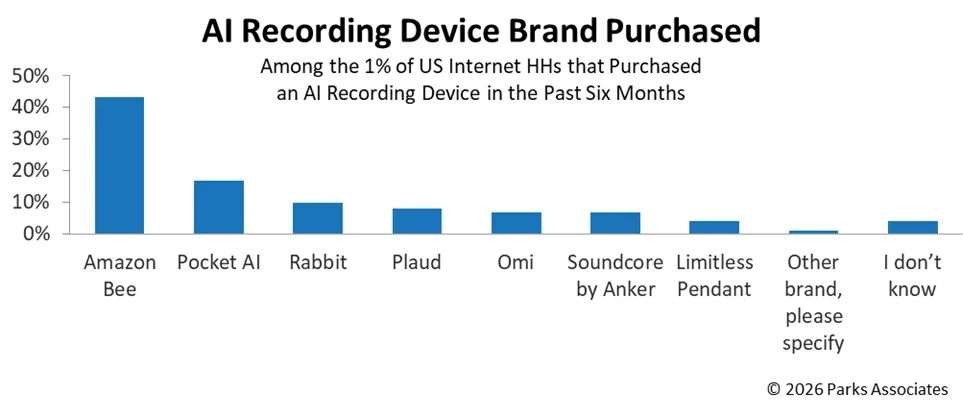
Apple is not alone in making AI personal and mobile. Amazon’s acquisition of Bee gives it a screenless wearable focused on ambient intelligence: capturing conversations, remembering commitments, and turning them into suggested actions. Amazon has a lead in the nascent AI recording category, but the market remains small and is still forming. The long tail of smaller brands offering stand-alone AI devices are competing in an emerging category where brand awareness, use-case clarity, and ecosystem integration will likely determine which players can convert early adoption into sustained market position. All must prove that a stand-alone device is necessary, when the same functionality is now built into the Apple Watch and phone-based applications like Otter.ai, AudioNotes and Notta offer similar functionality.
Meta is placing a much larger bet on glasses, explicitly positioning them as an ideal form factor for an all-day AI assistant that can understand the world from the wearer’s perspective. Google, meanwhile, is pushing Gemini deeper into its wearable ecosystem: Pixel Watch 5 is designed around Gemini Intelligence, while Fitbit/Google Health offers personalized health coaching built with Gemini.
Different companies are betting on different form factors, but they are chasing the same prize: making AI persistent, contextual, and available throughout the day.
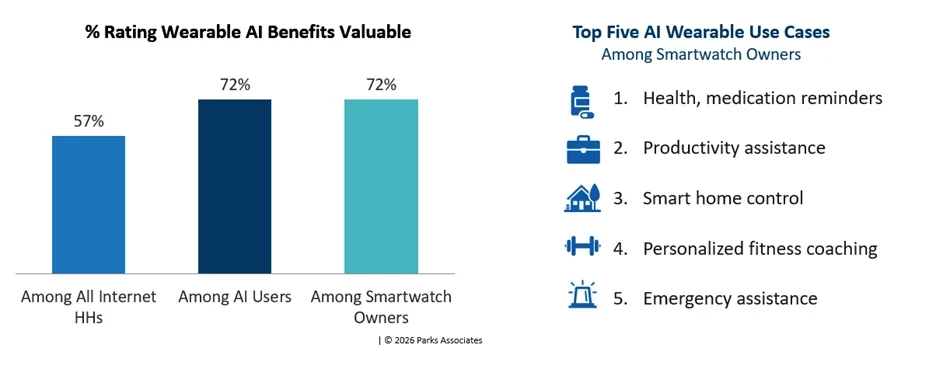
Personal health is where Apple has the strongest opportunity to differentiate. 73% of AI users, representing 43% of U.S. internet households, have already asked an AI tool a health-related question. Parks Associates’ concept testing finds 57% of consumers in US internet households find wearable-based AI benefits valuable. This rises to 72% of smart watch owners. Leading AI value propositions for smart watch owners include health and medication reminders, productivity assistance, and smart home control.
But greater health intelligence raises the stakes for trust. Only about 43% of U.S. internet households currently consider AI reliable for health-related advice, and roughly 40% say it is reliable during emergencies. Apple’s emphasis on sensor accuracy, privacy, user control, and science-based insights is essential to earning permission for AI to play a larger role in health.
Brands working in wearable AI need to lead with use cases consumers already value, such as emergency assistance, medication reminders, and health monitoring, while clearly explaining how personal health data is protected and how AI insights are validated. The strongest opportunity is to bundle AI into service tiers that deliver peace of mind, coaching, and proactive alerts, but adoption will depend on reducing concerns around cost, privacy, and inaccurate recommendations.
Parks Associates AI research is published quarterly and investigates consumer adoption, interest, and willingness to pay for emerging AI product and service concepts. Reach out to learn more about how to access this research.