

Consumer AI Misses the Mark: NPS in the Same Range as Utilities
The past several years has seen a boom in technologies leveraging large language models, or LLMs, for generative AI applications. ChatGPT, Microsoft CoPilot, Google Gemini, and Anthropic's Claude have become household names, with chat interfaces appearing in search engines, common apps, and even on devices themselves. Companies like NVIDIA have pulled gen AI into gaming technologies such as DLSS, and a boom in corporate AI demand has led to trillions of dollars in data center spending.
But, do consumers even want gen AI? Parks Associates' consumer surveys point to a more negative response than tech giants and tech startup hopefuls may like to hear.
The first edition of our recently introduced AI Experience Dashboard draws on a Q4 2025 study of 4,000 demographically representative US internet households, where we asked respondents about their use of leading AI products and services, their willingness to recommend these services, and the impact that AI advertising has on their likelihood to buy, among other measures. As of the end of 2025 most US households have had some experience with gen AI, with usage approaching 60% among heads of households.
However, when we look at net promoter scores, a measure of consumer willingness to recommend products and services, a stark reality emerges: consumers are not excited about gen AI. Indeed, some widely adopted solutions have more users who are negative about them than positive.
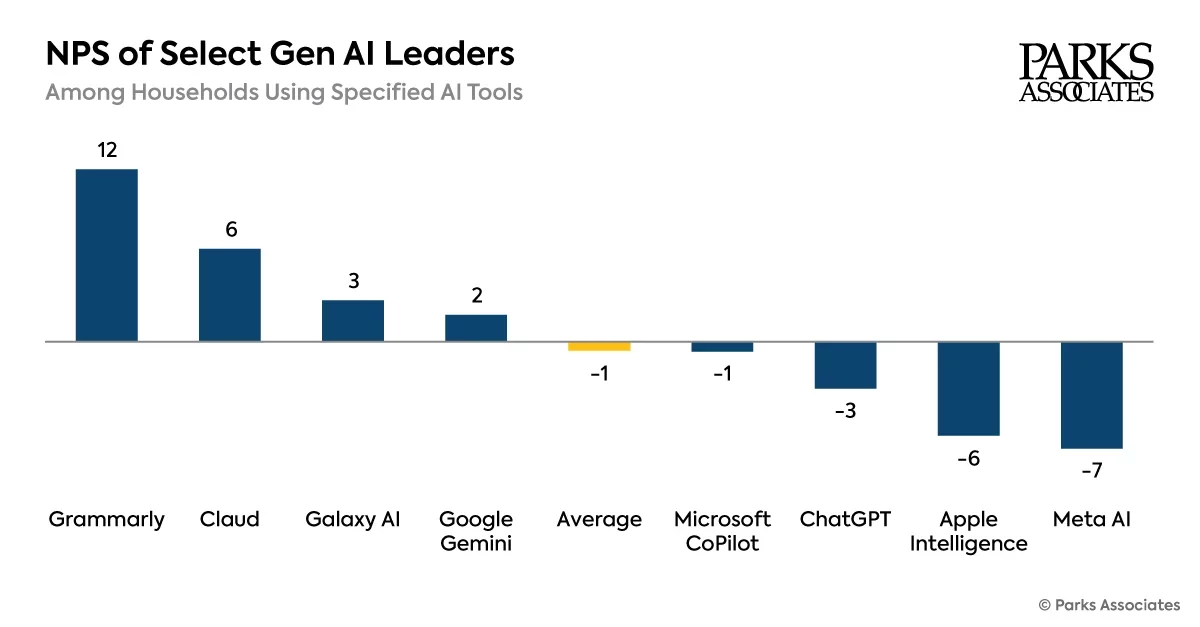
Average NPS for tech products is typically much, much higher than what we see for large language models. In 2025, the average NPS for smartphones was 44 and the average NPS for smart TVs was 30, many points higher than any tested gen AI model. Grammerly, the most positively received of the tested gen AI applications, still has a lower NPS than the humble desktop PC with its score of 18.
Home internet service providers, which have historically been somewhat challenged in terms of their NPS, also come out ahead compared to gen AI. In Q4 2025 the average NPS for home internet service was 6, putting it seven points ahead of the average for tested gen AI models. A typical consumer is more likely to recommend their home internet service provider than ChatGPT, Microsoft CoPilot, Apple Intelligence, Google Gemini, or Samsung’s Galaxy AI.
In fact, gen AI’s average NPS is closer to what we would typically see for a utility provider, if not somewhat worse.
When we look at the impact of AI-messaging on consumer-reported likelihood to buy products, the effect becomes even more negative: consumers are less likely to purchase products if they are advertised as including “AI.” This effect has worsened since 2024, even as adoption of gen AI solutions (and consumer familiarity with these solutions) grew.
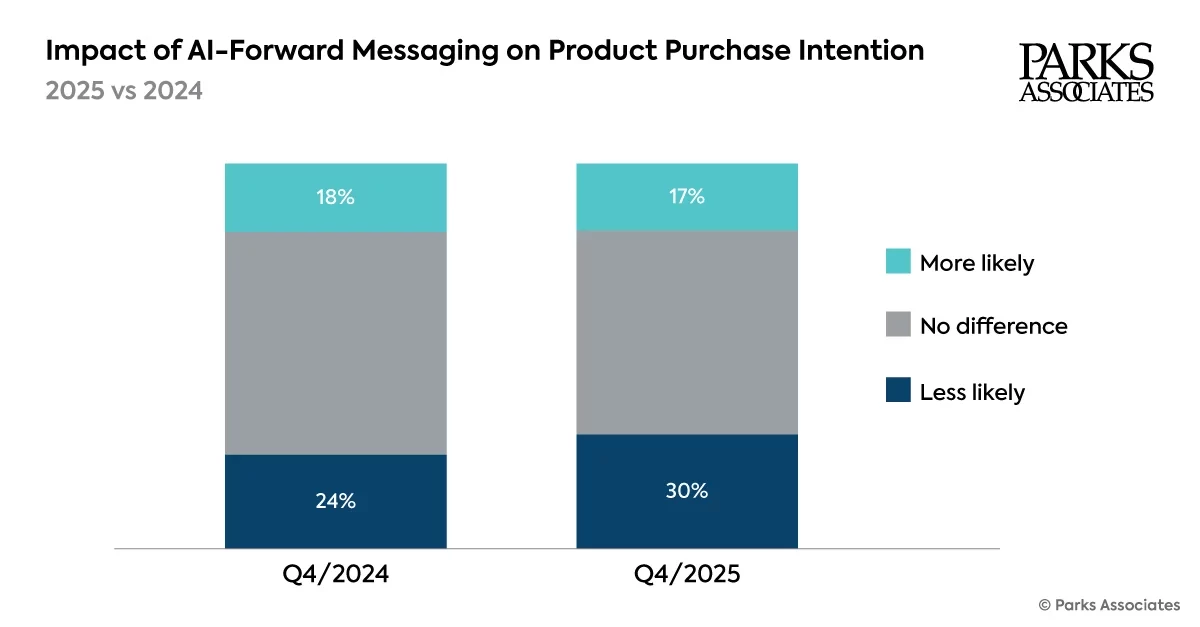
What does this mean for the tech companies that have invested billions of dollars into these products and services? The research shows that there are use cases for AI that resonate with consumers. Nearly 60% of those using a tested AI model agree with the statement that they “like, enjoy, and appreciate AI,” a higher percentage than its NPS would imply. But consumers also have strong concerns about privacy, ethics, and the societal impact of these technologies. And sticking a chatbot into everything isn’t what users are looking for.
It is essential for companies to make data-driven decisions based on what their users actually want. Ignoring users in favor of chasing hype creates long-term business risks that may poison the well for consumer AI applications for years to come.
Related Research:
- Parks Associates’ AI Experience Dashboard captures evolving consumer sentiment, adoption, and usage of AI, including uptake of paid AI offerings.
- Parks Associates’ Tech Ecosystem Dashboard visualizes the most important metrics informing the strategic decision making of companies connected to the leading consumer electronics devices in the home