

OpenAI's reported plans to introduce a portable, screenless AI companion have sparked new conversations about the future of voice-enabled devices. While the product has not yet been announced, reports from Bloomberg suggest it is being designed to move beyond today's voice assistants by offering more natural conversations, contextual awareness, and personalized assistance throughout the day.
Whether the device ultimately becomes a new product category or evolves alongside today's smart speakers, the announcement highlights an important shift in the connected home. The next generation of voice-enabled devices is expected to be defined less by hardware and more by intelligence.
Parks Associates research shows the smart speaker market is well positioned for this evolution. Forty-nine percent of US internet households own a smart speaker or smart display, making it one of the largest installed bases in the connected home. Adoption has largely stabilized over the past several years and even dropped since 2022, indicating the market has moved beyond rapid household penetration and into a replacement cycle.
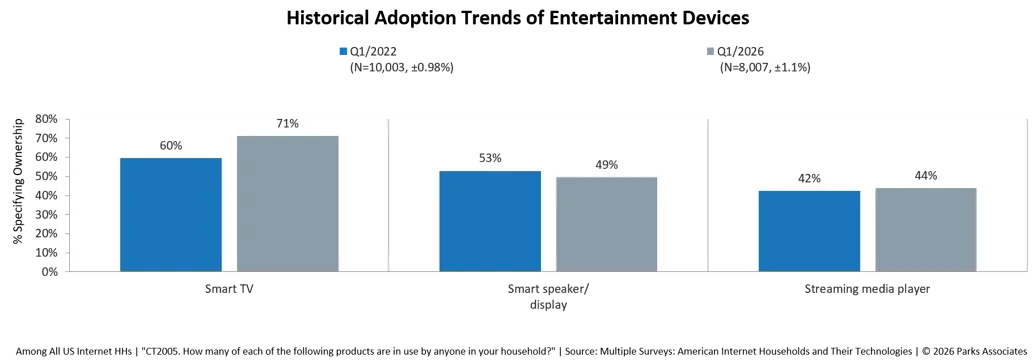
Purchase activity tells a similar story. Approximately 5% of US internet households purchased a smart speaker during the previous six months, while 18% intend to purchase one, down from approximately 21% in Q1 2025. Consumers are not walking away from voice technology. Instead, they appear to be waiting for meaningful improvements before replacing existing devices.
AI could provide that catalyst.
The first generation of smart speakers made voice control part of everyday life. Consumers use these devices to play music, control smart home products, answer questions, and manage simple household tasks. The next generation is expected to offer a much broader set of capabilities, using generative AI to understand context, remember preferences, coordinate connected devices, and provide more personalized assistance.
For manufacturers, this creates an opportunity to drive a new replacement cycle. Consumers who already own a smart speaker may be willing to upgrade if AI delivers a noticeably better experience rather than incremental hardware improvements.
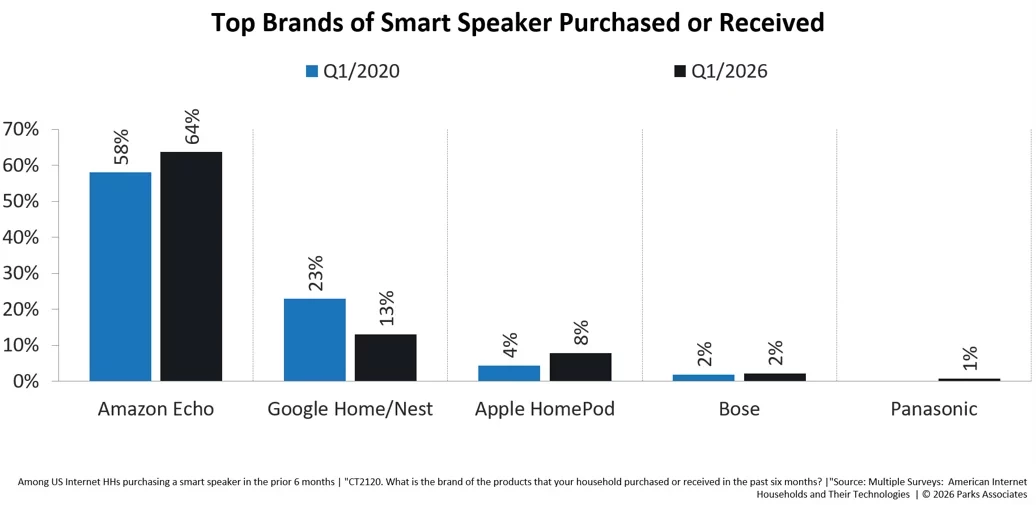
Today's market remains firmly led by Amazon. Parks Associates research finds Amazon Echo accounted for 64% of smart speaker purchases in Q1 2026, compared with 13% for Google Home/Nest and 8% for Apple HomePod. Amazon also continues to lead the smart display market, representing 78% of recent purchases. These results reflect Amazon's long-standing investment in Alexa and its broader connected home ecosystem.
The emergence of AI-native devices has the potential to change how companies compete. Future platforms will be evaluated not only on hardware design or voice recognition, but also on how well they understand users, integrate with connected devices and services, and simplify everyday activities.
This trend is consistent with broader findings from Parks Associates. Across the connected home, value is increasingly shifting from individual devices to integrated ecosystems that combine hardware, software, services, and AI. As consumers add more connected products to their homes, they expect those devices to work together seamlessly while delivering more personalized experiences.
The implications extend well beyond device manufacturers. Broadband providers, security companies, utilities, and smart home platform providers all have opportunities to integrate AI into their customer experiences. Voice-enabled AI can simplify home management, strengthen customer engagement, and create new opportunities for recurring services.
OpenAI's reported hardware plans may represent only one example of where the market is headed, but they reinforce a larger industry trend. The smart speaker market has reached maturity, yet AI has the potential to redefine the role these devices play in the connected home. The next wave of innovation will focus less on adding another connected device and more on creating intelligent assistants that become a central part of everyday life.