

The Intelligent Home: The Next Phase of the Connected Home
Over the past three decades, the connected home market has focused on device adoption, connectivity, and interoperability. Today, as adoption reaches the mainstream, the next phase of growth will depend on platforms and services that can orchestrate the home more intelligently. This theme was covered extensively in Parks Associates 30th year of CONNECTIONS™ in Santa Clara. This editorial also covers this evolution in greater detail, drawing from the latest Parks Associates consumer research.
The Smart Home Market Has Entered Its Platform and Intelligence Era
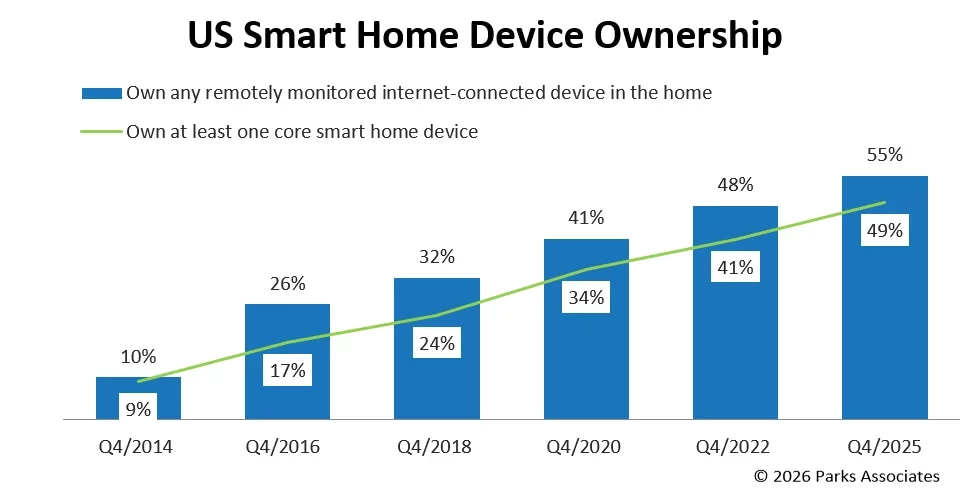
Half of US internet households now own a smart home device or smart speaker/display, pushing the market beyond early adoption into a mainstream connected home environment. As device ownership expands, competition is shifting away from hardware alone toward the platforms, ecosystems, and services that control the customer experience.
The smart home industry is entering a new phase defined by better underlying interoperability and AI-driven experiences, with continued efforts to develop recurring service revenue. Consumers increasingly expect seamless onboarding, cross-brand compatibility, intuitive automation, and personalized control across growing numbers of connected devices. At the same time, loyalty remains fluid as households adopt multiple platforms and seek better experiences.
Several industry shifts are reshaping competition. AI is becoming central to platform strategies, security providers are expanding beyond monitoring into home management and energy services, and OEMs are increasingly pursuing recurring revenue through subscriptions and premium features. At the same time, Matter is reducing hardware lock-in and intensifying competition around user experience, reliability, and service value.
The next phase of smart home growth will be driven less by device ownership and more by which platforms can deliver trusted, intelligent, and interoperable experiences that simplify increasingly complex connected homes while creating long-term consumer engagement and recurring revenue.
Market Maturity Creates New Growth Opportunities
Parks Associates research finds 49% of internet households now own at least one core smart home product, and more than half own a smart speaker or smart display. As the market matures, solution providers are serving customer segments that are at very different stages of their smart home journey.
- 26 million households are Power Users, owning 6 or more devices. Once a household crosses this threshold their control needs and interest in more sophisticated routines and experiences rises dramatically. These households overwhelmingly have children at home and higher affinity for technology.
- 20 million households are Newbies, owning just 1 or 2 devices. These households use smart home devices as point solutions solving a specific need. They over-index as identifying in the “Early Majority” of tech affinity, making them practical buyers who seek clear value and utility.
As smart home adoption reaches the majority of internet households and device counts steadily rise, the industry’s next growth opportunity shifts from selling connected devices to delivering services that simplify management, deepen engagement, and create recurring value across increasingly connected homes.
Competition Shifts to Platforms, Ecosystems, and AI
As device counts rise, consumers do not consolidate control into one interface; instead, they add more control layers, often controlling some devices through a leading ecosystem and others through dedicated apps.
Matter is designed to allow users to control all of their devices from their primary interface – and this is the #1 benefit that would drive smart home users to switch their primary control platform. That said, households have a wide array of legacy products that do not support Matter, and it will be years before this vision is achievable.
Instead, OEMs are faced with supporting integration across leading platforms. Alexa, Google Home, and Apple HomeKit support are must-haves to meet the needs of mass market consumers. Integrations with security brands and SmartThings open brands up to valuable Super Power User households.
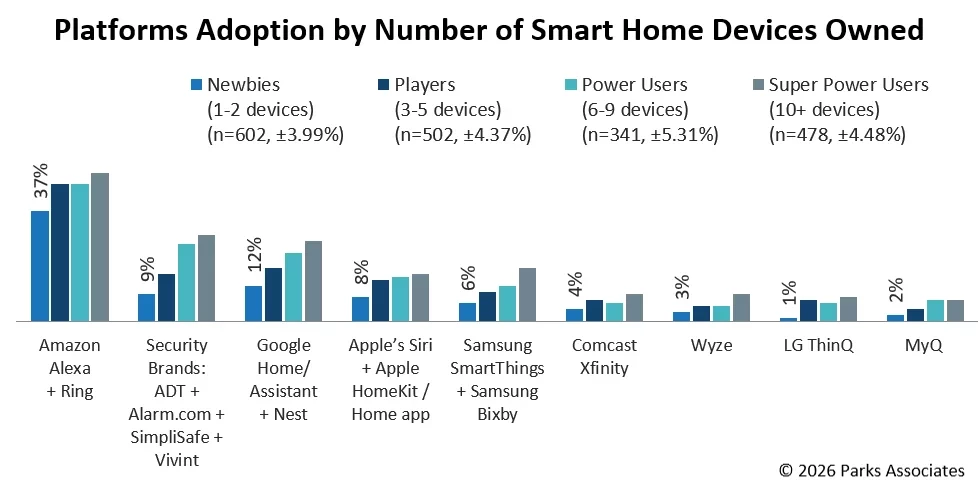
As smart homes become more device-dense, consumers rely on multiple control layers rather than a single platform, making interoperability, ecosystem partnerships, and security-platform integration critical for OEMs seeking relevance in high-value smart home households.
Platform Competition Shifts Toward Intelligent Experiences
While the controls market is decidedly multi-platform, Amazon has a strong lead considering both its Alexa and Ring assets. More than a third of households using a control platform consider Alexa or Ring their primary control platform, even as the market continues to fragment.
Google and Apple saw share decline in Q4 2025 and Google/Nest receives below-average NPS. The decline in primary-platform share for Google Home and Apple HomeKit comes as both companies are actively repositioning their smart home strategies around generative AI and more conversational experiences. Google’s launch of Gemini-powered home experiences and Apple’s investment in a next-generation Siri reflect broader efforts to make smart home control more intelligent, proactive, and context-aware.
The challenge for platform providers will be developing value beyond device connection and controls and translating AI innovation into reliable, everyday household value. Consumers seek simplicity, trust, and dependable performance, meaning next-generation assistants must improve practical home management experiences—not just introduce new conversational capabilities.
The Monetization Opportunity Lies in Outcomes
AI providers have fertile ground for tackling home security and smart home use cases. Smart home device and security system owners both use and pay for AI tools at rates far higher than the average household.
These customers are already comfortable with voice assistant use via smart speakers and have benefited from AI-powered features like object/person distinction and false alarm reduction for years.
The critical question is whether new LLM tools and players will add new competition to an already fragmented smart home platform landscape and/or will disintermediate the brands active and established in the smart home space (device OEMs, platforms, security providers, ISPs, etc.).
AI players can invest in smart home applications with confidence that this segment is open to AI-powered experiences. Other smart home brands need to make a move on their LLM strategies to keep up: build, white-label, or partner.
Demand for Intelligent Services Is Tied to Clear, Tangible Outcomes
Smart Home OEMs and platforms seek service opportunities to generate recurring revenue. Parks Associates tested seven intelligent services with all showing potential to generate billions in annual service revenues.
Cybersecurity monitoring leads, as consumers increasingly recognize the connected home as a risk environment and may be willing to pay for elevated protection. Maintenance monitoring, Context-aware home security, and energy optimization also show potential, suggesting that services framed around preventing problems, reducing false alerts, lowering costs, or improving peace of mind have the best near-term monetization path.
Intelligence itself, in the form of more capable and conversational assistants and agentic, automated experiences, is least able to command service premiums today. The intelligent home service opportunity is real, but demand is strongest when AI and connectivity are packaged around concrete consumer outcomes—protection, prevention, savings, and support—creating a path for OEMs, security providers, utilities, and platforms to build recurring revenue beyond hardware.
This editorial includes data from the Quantified Consumer study Smart Home Platforms: UX, Loyalty, Monetization.
This is an excerpt from Smart Home and Security Market Tracker, a research service that provides market intelligence on the competitive US Smart Home and Security landscape by sizing and forecasting the overlapping markets and providing an analysis of key industry trends, market shifts, and player announcements on an ongoing basis.
It also provides competitive analysis of key product categories in the Quarterly Market Update: Platforms, Products, and Forecasts (Excel). Request more information.
This service also includes access to Smart Home and Security Device Product Forecasts. Delivered once per year as part of the Platforms & Products Landscape, this research provides a 5-year forecast of unit sales and revenue for the leading product categories in the smart home market through 2030. It helps brands assess market growth rates. Forecasted devices include:
Consolidated smart home market view
- Smart video doorbells
- Smart cameras
- Smart door locks
- Smart smoke/CO detectors
- Smart garage door openers
- Smart water leak detectors
- Smart thermostats
- Smart lights
- Smart plugs/power strips
- Smart robot vacuums
- Smart in-wall switches
- Smart sprinklers/irrigation controllers
© Parks Associates