

Sony and TCL have agreed to form a strategic joint venture in their television and home entertainment business, under which TCL Electronics will hold a 51% controlling stake and Sony will retain 49% and the Bravia brand. The arrangement, currently at the memorandum-of-understanding stage, is expected to be finalized by March 2026, with operations beginning as early as April 2027, pending regulatory approvals. The new company will oversee the full value chain for TVs and home audio products, from development, design, and manufacturing to sales, logistics, and support, with products continuing to carry the Sony and BRAVIA brands.
This joint venture is poised to reshape the global TV market’s competitive dynamics, with implications for pricing, market share, supply chains, and brand strategies, while simultaneously having meaningful implications for TV OS vendors, by shifting scale, bargaining power, and platform alignment in the global TV ecosystem.
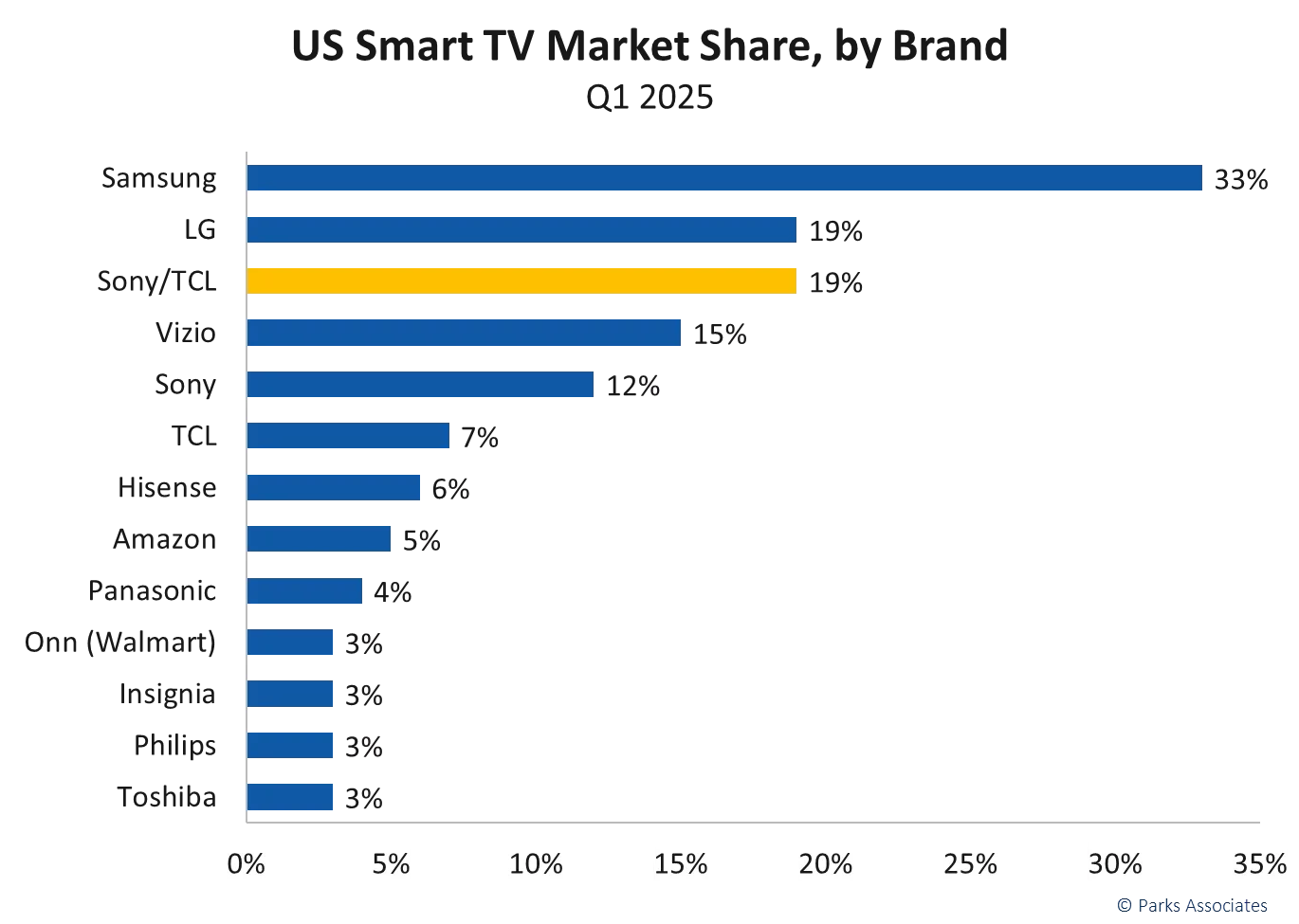
According to Parks Associated data, Samsung was the #1 smart TV brand in the US in Q1 2025 with 33% of internet households owning one or more, followed by LG (19%) and Vizio (15%). When this JV is finalized, the combined market share of Sony (12%) and TCL (7%) will have eclipsed that of Vizio and put them on par with LG.
If executed well, this partnership creates a new TV power player that combines Chinese manufacturing scale with one of the strongest premium brands in consumer electronics—reshaping competition not just for TV brands, but for smart TV platforms as well.
The implications are huge for both brands and their competitors:
TCL
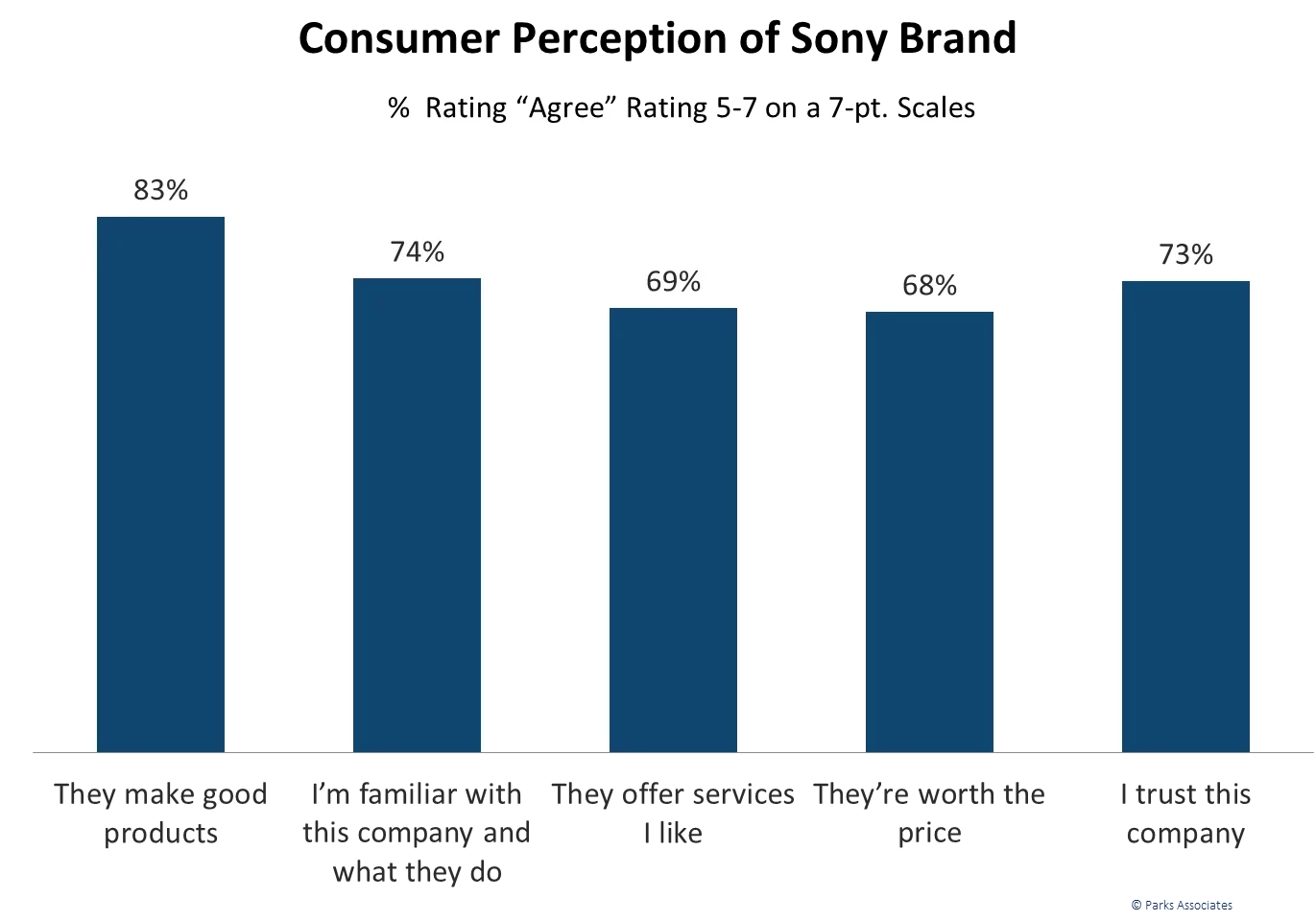
For TCL, this joint venture is a strategic step up the value chain. By taking a controlling 51% stake in Sony’s TV and home-audio business, TCL gains direct access to one of the most respected premium TV brands (Sony/BRAVIA), along with Sony’s image-processing, audio tuning, and system-integration expertise. According to Parks Associates data, 83% of US internet households feel that Sony makes good products and an additional 73% feel the Sony brand is one they can trust.
This significantly accelerates TCL’s long-standing ambition to move beyond its perception as a value or mid-tier brand and compete more credibly in the high-end and premium segments, especially in developed markets like North America, Europe, and Japan where Sony’s brand equity is strongest.
Operationally, the JV strengthens TCL’s scale, utilization, and influence across the TV supply chain. TCL can better leverage its manufacturing footprint and display arm (CSOT) to drive volumes, improve cost efficiency, and shape technology roadmaps (e.g., Mini-LED, advanced LCD). At the same time, managing a premium global brand raises execution risk. TCL will be under pressure to maintain Sony’s quality standards to avoid brand dilution. If executed well, the JV could materially improve TCL’s global market share, margins, and competitive positioning versus Samsung and LG; if not, reputational risk becomes the main downside.
SONY
For Sony, the JV is a clear move to de-risk and de-emphasize low-margin hardware manufacturing while preserving upside from its TV business. By ceding majority control to TCL, Sony reduces exposure to rising panel costs, pricing pressure, and inventory risk in a brutally competitive TV market, while still retaining a 49% stake and the BRAVIA brand. This allows Sony to stay present in TVs without having to carry the full operational and capital burden, effectively turning TVs into a capital-lighter, partnership-driven business rather than a core manufacturing one.
Strategically, the JV lets Sony refocus resources on higher-return areas where it has structural advantages, such as gaming (PlayStation), image sensors, content, music, and services. The key upside is continued monetization of Sony’s image processing, audio technologies, and brand equity, potentially at greater scale through TCL’s manufacturing reach. The main risk is brand dilution. Sony’s premium positioning depends on execution quality that TCL must consistently deliver. If managed well, the JV stabilizes Sony’s TV presence and margins; if not, Sony risks weakening one of its most iconic consumer brands.
Competitor TV Brands
For Samsung and LG, the Sony–TCL JV raises competitive pressure at the premium end of the TV market. Sony-branded TVs backed by TCL’s scale could become more cost-competitive without immediately sacrificing perceived quality, narrowing the pricing gap that Samsung and LG have relied on to defend share in upper-mid and premium segments. Samsung, which dominates volume and pushes QLED/Mini-LED, may face tougher competition if the JV accelerates Mini-LED adoption under the BRAVIA brand. LG, meanwhile, could see intensified pressure in premium categories if Sony/TCL push aggressively on LCD-based alternatives to OLED, potentially slowing OLED penetration or forcing sharper pricing discipline.
For other TV manufacturers, the JV reinforces a broader industry trend toward consolidation and asymmetric competition. Chinese brands (Hisense, Xiaomi, Skyworth) face a stronger rival that combines Chinese manufacturing efficiency with a top-tier global brand, making simple price competition harder. At the same time, smaller Japanese and regional brands may struggle further as Sony’s move signals that standalone TV manufacturing is increasingly unsustainable without scale. Overall, the JV is likely to accelerate margin compression, faster technology cycles, and sharper brand stratification, pushing the industry toward fewer, larger players with clearer roles across premium, mid-range, and value segments.
TV OS Platforms
Sony-TCL JV also has significant implications for TV OS vendors, by shifting scale, bargaining power, and platform alignment in the global TV ecosystem.
First, the JV potentially concentrates OS decision-making for a large block of Sony- and TCL-branded TVs under one operational roof. Today, Sony TVs are closely associated with Google TV (Android TV), while TCL supports multiple platforms (Google TV, Roku TV, Fire TV, and others depending on region). Post-JV, TCL’s greater operational control could drive greater platform rationalization to reduce complexity and costs. That favors Google TV, which already has deep penetration with both brands, but it also creates risk for secondary platforms (e.g., Roku TV in certain regions) if they lose volume commitments tied to Sony models.
Second, the JV strengthens the hand of large, horizontally scaled OS providers while weakening niche or proprietary platforms. With TCL managing manufacturing at scale, and being the largest TV manufacturer that does not have its own 1st party TV OS, OS vendors will face tighter commercial terms, more pressure on revenue-sharing, and higher expectations around monetization (e.g., ads, content discovery, FAST integration). For Google, this could mean stronger leverage but also greater scrutiny around fees and data-sharing. For Amazon (Fire TV) and Roku, the JV could become a gatekeeper negotiation point rather than multiple independent OEM relationships.
Thirdly, the new Sony-TCL entity could decide that given its scale the time was ripe for it to either develop its own 1st party TV OS or acquire one, such as Roku, TiVo OS, Whale TV, or Titan OS. While Roku has never commented on this, many have hypothesized that Comcast might be interested in acquiring them. Based upon this JV, Sony-TCL might be another interested party.
Finally, the JV underscores the declining viability of OEM-owned or lightly scaled TV OS strategies. As hardware margins compress, OS and services revenue matter more but only platforms with global scale, content depth, and ad infrastructure will benefit. The net effect is likely fewer OS platforms with larger footprints, faster consolidation around Google TV (and possibly Fire TV in select markets), and rising pressure on OS vendors to prove they can materially lift TV manufacturer profitability, not just enable smart-TV functionality.
Parks Associates Tech Ecosystem Dashboard provides an ongoing assessment of leading TV brands and operating systems in the US.

