A recent Parks Associates and Cox Communities study found that more multifamily residents with home internet can get access to gigabit download speeds.
In a new white paper, A Guide to Connectivity Innovations in Multifamily Housing, in partnership with Cox Communities, Parks Associates research shows that nearly one in five multifamily residents with home internet could get gigabit or faster download speeds.
Parks’ research considers various connectivity options available for multifamily properties, including legacy bulk and retail service, managed Wi-Fi, and the increasingly popular trend of instant activation.
The research found that the expectations in terms of available speeds are increasing. About one in five multifamily residents with home internet reported receiving gigabit or faster downlink speeds as of late 2024. Further, Parks noted that customer satisfaction with home internet is highest among those with these high speeds and lowest among those with low speeds.
Gigabit speeds will be a key consideration. “Gigabit – and even multigigabit – internet will be increasingly important as a resident amenity in the coming years,” Parks said in its study.
Kristen Hanich, director of research for Parks Associates, said that “the owners and operators of multifamily properties must consider the implications of deploying connectivity to new construction versus existing buildings and evaluate their goals, the costs of deployment, and the potential payoff.”
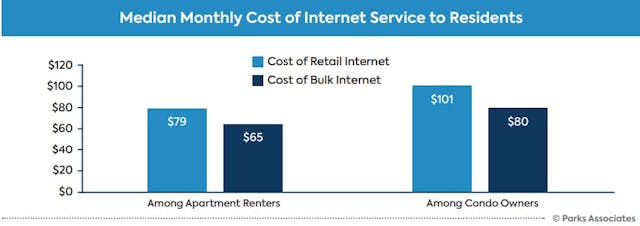 Parks found that there are several cost differences for residents who pay for a retail or a bulk internet plan.
Parks said that “condo owners report higher rates of satisfaction with their home internet than apartment renters do, even though their costs are higher,” but added that “this analysis excludes those whose bulk internet costs are aggregated into their monthly rent.”
Despite its benefits, Parks noted that “bulk internet is not always the preferred option – existing exclusive marketing agreements as well as a local market with competitive retail internet providers offering low-cost plans, make bulk internet less desirable.”
Parks Associates, in its analysis, saw that the median average cost of these fees at $75 per month for renters and $80 per month among condo owners.
However, the research firm said the cost of these fees varies by what market the property is located.
“There are large differences in fee amounts according to geographic region: Los Angeles, a highly in-demand market, boasts a median tech amenity fee nearly twice as high as the national average,” Parks said. “These fees, as well as installation of the technology generally, help boost overall property NOI and increase valuations.”
While bulk internet might not be the right fit for every property, Parks saw that properties with bulk internet overall have a higher net promoter score (NPS) than properties that don’t have it today.
From the article, "Multifamily resident access to gigabit or faster download speeds is rising" by Sean Buckley